Caleb Jones

Hedcut portrait of Caleb Jones

Caleb Jones is a speaker and thinker deeply engaged with the intersection of Mormon theology, transhumanism, and intergenerational connection. His work focuses on the spirit of Elijah, as referenced in Malachi, and its implications for creating faith-based connections across generations, both living and deceased. He advocates for a broader interpretation of this principle, extending it beyond traditional temple work to encompass a reconciliation of ancient wisdom with modernity.

Jones draws upon G.K. Chesterton’s concept of the “democracy of the dead” to frame his exploration of tradition and remembrance. He posits that our ancestors, through their artifacts and influence, continue to participate in the present. He sees the redemption of the dead through these artifacts—books, music, laws, traditions—as a collective human endeavor involving various disciplines such as literary scholarship, archaeology, and religious studies.

His perspective emphasizes the importance of engaging with the past to inform and enrich the future, particularly within the context of Mormonism and its emphasis on family history and genealogical work. Jones champions seeking a healthy balance and ongoing reconciliation of the hearts and minds of the dead and dying with the hearts and minds of the living, to redeem rising generations.
Videos by Caleb Jones

Video Game Environments
21:36

Caleb Jones

Video Game Environments

Caleb Jones explores how video game environments model humanity's relationship with nature, distinguishing between passive worlds that serve merely as resources and active worlds that create feedback loops with players. Drawing on Linda Chang's book Playing Nature, he analyzes games from Minecraft's indifferent landscape to ECO's sophisticated ecological simulation, using frame analysis to uncover their ontological, normative, and strategic assumptions. Jones connects this to Mormon transhumanism by mapping the Transhumanist Declaration and Mormon Transhumanist Affirmation onto this framework, suggesting that virtual worlds could teach ecological concepts and embody a distinctly Mormon transhumanist environmental ethic.

Elijah and the Faith of Generations
19:14

Caleb Jones

Elijah and the Faith of Generations

Caleb Jones examines the Spirit of Elijah as a call for intergenerational reconciliation, arguing that turning hearts between parents and children must extend beyond temple work to address the living. Drawing on G. K. Chesterton’s “democracy of the dead,” Abraham Heschel’s critique of stale religion, and Book of Mormon narratives, he explores how religious traditions can become burdensome when preserved rigidly rather than renewed for each generation. Jones highlights research showing rising disaffiliation among young Latter-day Saints and urges a model where parents turn their hearts to children—trusting them to gather fresh spiritual “manna” and adapt faith to contemporary challenges.

Emergent Mormon Perspectives on Kurzweilian Epochs of Evolution
22:07

Caleb Jones

Emergent Mormon Perspectives on Kurzweilian Epochs of Evolution

Caleb Jones presents an emergentist interpretation of Ray Kurzweil's six epochs of evolution through the lens of Mormon theology. He traces the progression from atomic structures through biological evolution, neural development, technological advancement, and ultimately toward post-human consciousness—drawing parallels with Mormon teachings about eternal progression and the divine potential of humanity. Jones argues that Mormonism's naturalistic ontology and eschatology provide a robust framework for syncretizing science and religion, suggesting that traits emerging from each epoch carry forward into subsequent ones, with religion's adaptability being crucial for flourishing in technologically transformed futures.

Unto What Shall I Liken?
20:52

Caleb Jones

Unto What Shall I Liken?

Caleb Jones examines how semiotics—the study of signs and symbols—can transform our understanding of religious faith and revelation. Through the scriptural phrase “Unto what shall I liken?” he explores how revelation inherently involves encoding divine experience into limited human symbols, a process that breaks down between communicator and audience. Jones argues that this semiotic awareness invites self-reflection about religious symbols: rather than treating doctrine as fixed edicts, we can approach them as milestones in an evolving faith, recognizing that prophets speak through the “poor symbols our life affords” while disciples maintain responsibility to discern through charity and Christ-centered filters.

Mormonism and the Fractal Lineage of Gods
20:23

Caleb Jones

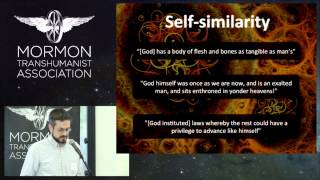
Mormonism and the Fractal Lineage of Gods

Caleb Jones presents Mormon theology through the lens of fractal geometry, proposing that the relationship between humanity and God can be understood as a fractal progression. Drawing on Joseph Smith’s teachings about the eternal nature of intelligence and Lorenzo Snow’s couplet—“As man now is, God once was; as God is now, man may be”—Jones argues that Mormonism’s ontology exhibits key fractal properties: self-similarity between humans and God, continuous line-upon-line progress, recursive self-referential laws, and infinite aesthetic variety. He suggests that fractal mathematics, pioneered by Benoit Mandelbrot, provides a richer symbolic framework than Joseph Smith’s original ring metaphor for understanding eternal progression, the temple ritual’s transgenerational symbolism, and the simulation hypothesis’s intersection with Mormon cosmology.