Jared Anderson

Portrait of Jared Anderson

Jared Anderson is a scholar of religion with a particular focus on the intersection of human limitations, religious power, and the potential of religious humanism. His work emphasizes the importance of understanding and harnessing religion’s enduring influence in the face of human cognitive biases and the need for societal evolution.

Anderson’s intellectual journey involved a re-evaluation of Mormonism through graduate studies and the subsequent exploration of world religions. This experience led him to recognize the pervasive impact of humanity on religion, a puzzle he continues to engage with. His research examines religion as a cultural technology, exploring its origins in managing belief in evil spirits and its subsequent evolution through tribal, agricultural, and Axial Age developments.

He frames the present state of religion as an outdated cultural technology, advocating for a proactive approach to redirecting its influence in a rapidly changing world. His current focus is on facilitating the continuation of civilization infrastructure until the Singularity, a race against the death between innovation and cataclysm. His presentation given at the Mormon Transhumanist Association Annual Conference highlights his efforts to challenge and correct the limitations humans are so prone to.
Videos by Jared Anderson

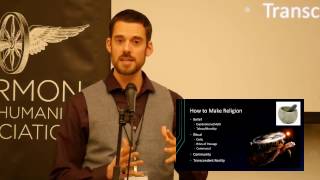
The Past, Present, and Future of Religion
23:23

Jared Anderson

The Past, Present, and Future of Religion

Jared Anderson examines religion through the lens of human cognitive limitations, arguing that religion is a powerful cultural technology that has evolved alongside humanity. He traces religion's origins to our evolutionary need for hyper-agency detection and explains how shared ritual transformed individual superstition into a uniquely effective mechanism for cooperation and social cohesion. Anderson presents demographic data showing that religion will remain dominant globally through 2050, with Islam as the fastest-growing faith, while noting that fundamentalist movements outperform progressive ones in providing psychological and social goods. He challenges both religious and secular audiences to recognize religion's enduring power and calls for innovative approaches that can harness its potential while addressing its limitations—framing this as a "race to the death between innovation and cataclysm."

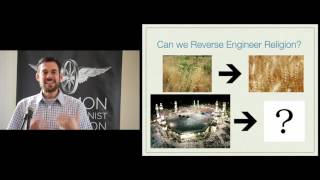
Reverse-Engineering Religion
21:13

Jared Anderson

Reverse-Engineering Religion

Jared Anderson, president and founder of the Olan Institute, proposes "reverse-engineering religion" to harness its unique cultural power for addressing humanity's urgent problems—climate change, inequality, conflict, and more. He argues that religion is the most powerful cultural technology ever developed, yet it is often aimed at the wrong targets. Anderson outlines a framework for creating "religious humanism": a high-church tradition with rigorous rituals, community structures, and beliefs that allow for both literal and figurative interpretation. His vision includes denominations like Earth Church (environmentalism), Life Church (education and science), and Tech Church (transhumanism).

(De)Construction down the Rabbit Hole
16:43

Jared Anderson

(De)Construction down the Rabbit Hole

Jared Anderson explores three approaches to faith crisis: apologetics, which defends inherited beliefs but leaves adherents vulnerable to new information; selective emphasis, which rebuilds meaning by highlighting a tradition’s most beneficial elements; and complete reconstruction through new myths and systems of meaning. Anderson argues that critical inquiry can only demolish worldviews—reconstruction is an art requiring theology, aesthetics, relationships, heritage, syncretism, and activism. He concludes that humanism and transhumanism offer frameworks for rebuilding when the “rabbit hole goes all the way down.”