Michaelann Gardner

Portrait of MichaelAnn Gardner

Michaelann Gardner is a speaker who has presented at several Mormon Transhumanist Association conferences. Her presentation at the MTAConf 2019 focused on the impact of family history and ancestral trauma on personal well-being and resilience, particularly in the context of emotional vulnerability and mental health.

Gardner’s talk explored the challenges of confronting difficult family narratives and embracing personal messiness and complexity. She drew on personal experiences related to her grandfather, Bert Gardner, and great-grandfather, both of whom struggled with alcoholism and created instability for their families. She connects these family dynamics to broader themes of emotional expression, financial security, and anxiety.

She integrates insights from therapy and psychology, referencing research that suggests building resilience through understanding one’s family history. Her work appears to be a combination of personal reflection with family systems and positive psychology.
Videos by Michaelann Gardner

Healing the past and raising the future
12:23

Michaelann Gardner

Healing the past and raising the future

Michaelann Gardner reflects on how intergenerational trauma—passed down through her alcoholic grandfather and great-grandfather—continues to shape her family's struggles with emotional vulnerability and security. Rather than fleeing from this difficult heritage, she argues that redemption comes through embracing one's particular history: "We live in details, not abstractions." Using Beyoncé's Lemonade as an illustration, Gardner contends that healing emerges when we connect ourselves to our past and to each other, transforming inherited pain into strength for future generations.

Overcoming Death
18:16

Michaelann Gardner

Overcoming Death

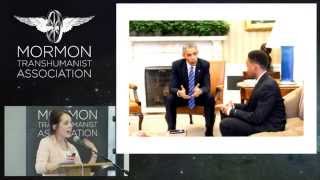
Michaelann Bradley, MTA CEO, confronts mortality head-on, using a clip from "The Good Place" to illustrate how awareness of death gives actions meaning. She argues that transhumanism offers a middle ground between existential despair and the cavalier Mormon attitude that "suffering is just a blip." If our descendants must become gods who enact the resurrection through scientific principles, our present actions take on profound significance. Bradley shares her personal commitment to "come back" for her ancestor Mary Rosetta Patterson and calls for MTA members—marketers, scientists, organizers—to help build an organization that moves beyond theology into action, shaping the ethics of an inevitable transhumanist future.

A Meditation on the Cross and on the Bread
15:51

Michaelann Gardner

A Meditation on the Cross and on the Bread

Michaelann Bradley offers a transhumanist meditation on Christianity's two central symbols: the cross and the communion bread. She contrasts the 30,000-year history of bread-making—a cumulative technological miracle of fire, agriculture, and fermentation passed down through generations—with humanity's equally inventive history of torture and judicial killing. Rather than finding cosmic meaning in the extremity of Christ's suffering, Bradley locates redemption in the simpler act of communion: the sharing of sustenance made possible by ancestral ingenuity. For transhumanists creating vitamin pills, coding platforms, or virtual reality, this reframing suggests that small technological contributions to human flourishing are themselves sacramental acts of rebellion against the cross. The presentation concludes with a congregational hymn sung to the tune of "If You Could Hie to Kolob."

Artificial Intelligence and Suffering
16:10

Michaelann Gardner

Artificial Intelligence and Suffering

Michaelann Gardner explores whether Mormon theology provides space for sentient artificial intelligence. She examines LDS scripture on intelligences, the spiritual nature of animals, and passages where objects like stones and the earth itself express emotion—suggesting that consciousness may not be exclusive to biological brains. Gardner argues that sentience, with its capacity for desire and subjective experience, may be key to developing AI that can solve complex real-world problems, and proposes that the most fruitful path forward may be human-machine integration rather than standalone artificial general intelligence.

Social Mind Upload: Unleashing our Empathy
16:33

Michaelann Gardner

Social Mind Upload: Unleashing our Empathy

Michaelann Gardner argues that social media functions as a kind of “social mind upload” that can help address three transhumanist fears: perfecting the human race at the expense of individuals, technology disconnecting us from our humanity, and advanced technology benefiting only the wealthy. Drawing on research about empathy—how reading novels activates emotional intelligence, how images of suffering stimulate the vagus nerve, and how living in diverse communities increases generosity—she demonstrates that social media mirrors all three empathy-building mechanisms. Using the viral story of Vidal, a young boy from a struggling New York school whose community raised $1.4 million through crowdfunding, Gardner illustrates how these platforms can break down social barriers, connect strangers around shared causes, and help “turn the ship of technology” toward the good.

Turning Our Moral Compass: the Environment and Mormonism's Theology of Means
14:00

Michaelann Gardner

Turning Our Moral Compass: the Environment and Mormonism's Theology of Means

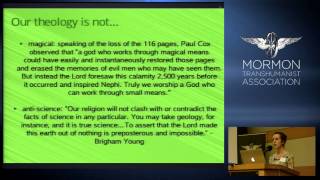
Michaelann Gardner argues that Mormon culture has narrowly focused its moral compass on individual sexual purity while overlooking broader ethical responsibilities toward the environment. Drawing on LDS theology—which affirms that the earth has a spirit and that God works through natural means rather than magic—she contends that Mormonism is uniquely positioned to become a powerful environmental movement. Gardner suggests that transhumanism, with its emphasis on human agency and collective action, can help transform Mormon morality toward a more expansive ethic that embraces environmental stewardship as preparation for building Zion.