AI and Farming
Jeff Beck, a farmer and technologist, explores the intersection of artificial intelligence and agriculture. He discusses how modern farming is moving beyond monocultures and factory farming toward complex systems that leverage AI for precision agriculture—including targeted weed control, predictive maintenance through vibration sensors, and drone-based surveillance for crop monitoring. Beck emphasizes the distinction between natural and artificial intelligence, noting that farmers already use automated systems like robotic milking machines, while emerging technologies from companies like Blue River (acquired by John Deere) enable real-time plant species identification for selective spraying.
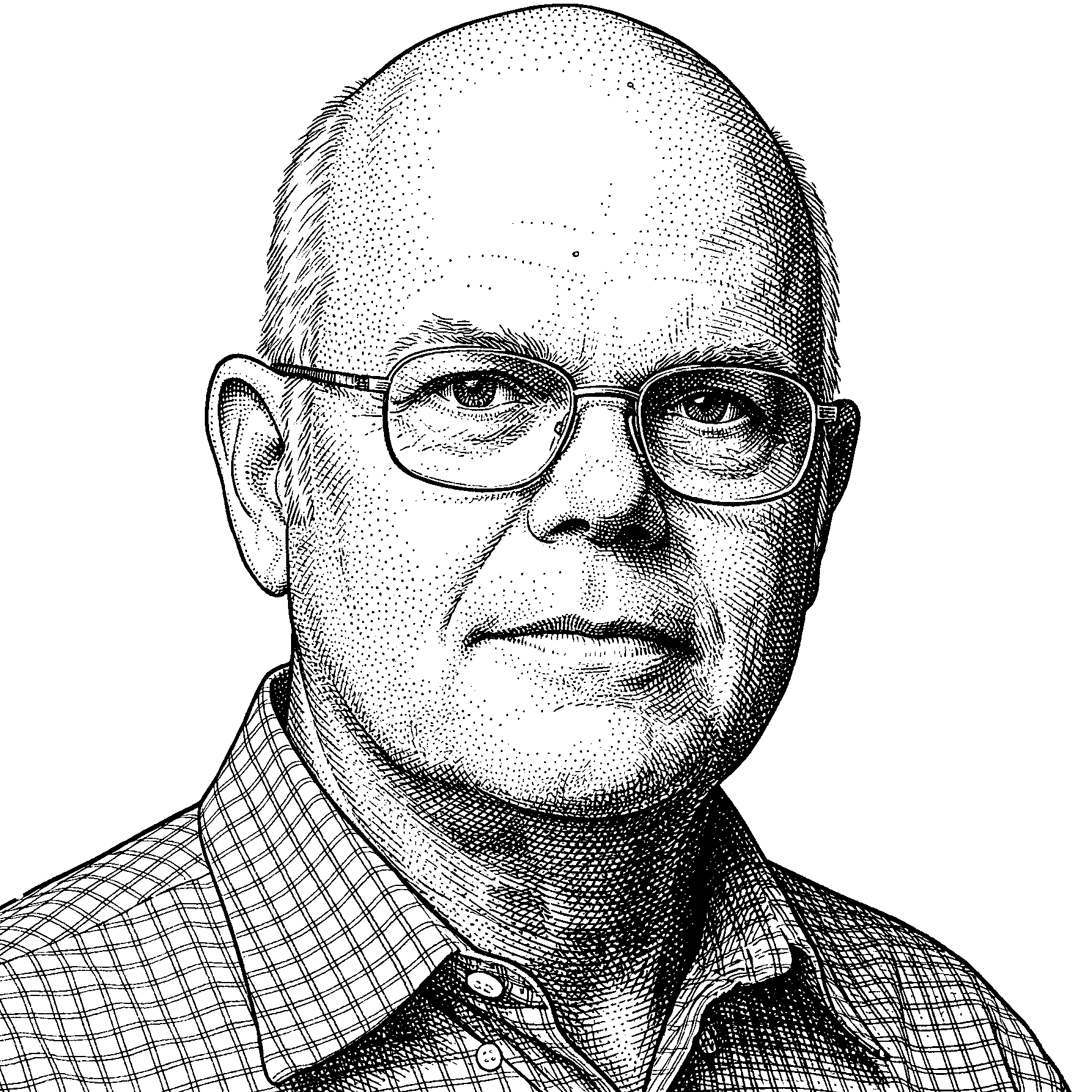
Jeff Beck is a farmer and independent researcher with a deep interest in consciousness and its underlying mechanisms. His exploration of these topics has led him to consider questions surrounding how meaning is encoded in the brain and the nature of reality beyond linguistic abstraction. Beck’s interest in transhumanism stems from a fascination with solving seemingly impossible problems. ¶ Prior to his current pursuits, Beck worked as a research engineer for Conoco, where he specialized in tackling challenging engineering problems related to coal slurry, horizontal drilling, and other complex industrial processes. He gained extensive experience in designing and building pilot plants with feedback loops and control systems, often working with air and hydraulics for safety in explosive environments. This work sparked an interest in self-regulating systems and their potential applications. ¶ Beck holds a master’s degree in system dynamics and controls, which provided him with a foundation for understanding complex systems and their behavior. He is particularly interested in exploring the connections between dual aspect monism, high-level construction, and the nature of consciousness, seeking to bridge the gap between linguistic representations and the underlying continuum of experience.
Transcript
Jeff Beck
So farming has historically been associated with something like artific anyway, it’s cultivation, it’s something something apart from the natural wild. World of hunter-gatherer societies. And today it’s it I mean, it’s associated with factory farming and monoculture systems and Those provide efficiencies that have economic reward, and that’s why we’re using a lot of them today. But amongst farmers, there’s an increasing understanding that we have to look at complex systems. Monocultures aren’t always a good idea. And especially in soil fertility, the advent of low-till and no-till cultivation is one aspect of that. And the just the consumer demands for more natural systems has been actually giving us an economic means to try and break out of that monoculture and factory farming system.
Jeff Beck
We talk about intelligence. I have a particular view of intelligence as So artificial intelligence is what’s not natural. And natural intelligence is built into the world. We’ve got There’s a lot of physics or kind of intelligence. The emergent patterns in chemistry and biology are based on this intelligence. And then within humans, it’s typically associated with what I would say is associated with conscious processes. The systems that we have created, they’ve all been created within conscious minds, and then we implement things that can be carried out through without current consciousness present.
Jeff Beck
As a farmer, I mean, I see this boundary Quite clearly, just in monotonous tasks. I mean, I do it. I mean, I’m not conscious. all the way when I’m doing my job. If I’m doing something monotonous, I’m my mind’s going someplace else and my body’s just doing its thing, running up and down the rows. And I think it’s important to recognize that there’s a boundary between this built in programmed intelligence, even in our human system, versus what it takes consciousness for. So we use our natural intelligence to build artificial intelligence, but our consciousness is incorporated by design into these artificial systems.
Jeff Beck
Right. So there’s a pretty good Wikipedia page that covers just from ideas on robotics. They’ve got different I also just wanted to share some different resources. They’ve got I mean, in this valley, we’ve got an automatic milking machine, basically. The cows know how to go the cows are on automatic, they they know the routine. They walk in, they get on this merry-go-round. They have people actually sanitizing the milking equipment, but it’s all just automatic. And there’s lots of different ways that you can use automation to minimize labor in agriculture, and there’s lots of incentive to do so. In general, agriculture has been leading tech applications just because there’s so much economic incentive to do it. There used to be half the population work 80% of it worked in agriculture. No, it’s 2% probably going towards 1%.
Jeff Beck
Bear, for instance, is trying to market data services and and they’ve got a a whole program Designed to try and make money on precision farming for the most part. There’s another one that I’ve going to the Consumer Electronics show the last couple times. Blue River’s been there. John Deere bought them out, and they’re doing their best to commercialize AIA-driven targeted spraying systems that use chemicals like Roundup to target weeds specifically in conserve the chemicals or ideally my point of view is this should be done probably with mechanical or something non-chemical. But they’re using the AI primarily to identify and differentiate different plant species so that they can target the cultivation.
Jeff Beck
One thing that I’ve come across in my own Just operation is that a lot of times there will be different vibration modes in machinery that’s going haywire, and so This article is about industrial applications for basically distributed AI that’s Looking at things out in the field. But then, if you do a two-level system where you’ve got an Internet of Things type AI process working remotely on specific devices and then a centralized AI that’s processing and identifying. And because like once you have a failure, then you can look at what were the precursor signals up to that failure. And then going forward, that’s basically a training system to train for in advance of having failures so that you can take corrective action before you actually have the breakdown. This one, this article’s specifically about, or this site’s trying to sell it for refineries, but works the same for agricultural systems, and that’s one that I’m really interested in because it’s cost me lots of money having failures that could have been predicted. with the just vibration sensors and monitoring and the right kind of AI system built into it.
Jeff Beck
They’re incorporating autonomous systems as drones to go through the basically do surveillance and collect data for precision farming. So they can create maps and then that’s integrated with the application of herbicides or fertilizer or anyway you can use basically just optical sensors to collect imaging data that can differentiate plant stress versus wetlands and and Low fertility areas based on plant stress and physiology that can be seen through optical imaging for the most part. And so these are all different extended articles that can be read. They’ve got a slideshow here on that one. But anyway, love its marketing, but it’s in the world and farmers are using it right now, big time, especially in the plains, not so much in Utah.
Jeff Beck
So I was hoping some of this could be about discussion. I mean, this is supposed to be just a s A room to do interactive discussions in.
Speaker 2
And maybe, Jeff, you might have questions for you, too. Are you open to having questions?
Jeff Beck
Yes, I’m just I was really hoping that we could have some discussion in the deal rather than just have a straightforward presentation. Anybody have any questions? Curiosities?
Speaker 3
So I had kind of I got a little bit of a sneak preview of your talk because I got to I got to help kind of screen some of the talks for the conference. So I’m curious, in addition to all of these kind of really big picture things, you mentioned something Like an eventual replacement for pesticide, um where
Jeff Beck
Can we anyway the Blue River systems doing plant recognition and targeting chemicals, but That same system could be used for other interventions rather than pesticides. It could be mechanical. is the most obvious one, or at least really tightly targeting pesticide applications. There’s some other work being done on basically autonomous robots that would use the same kind of plant recognition technology to j just wander around like the Roomba I di does and and we, you know, specifically mechanically destroy Invasive plants.
Speaker 3
So, how do you see your role as a farmer changing? Because it sounds like in the next, I don’t know, fifty years or so, suddenly a farmer will have to be an engineer or someone who works in robotics or AI.
Jeff Beck
I mean, the farmers around here are using drones to to do regular things that need to be done. works out really good on canal maintenance issues. They have programmable drones that you you can basically set them up to go spray an area and they’ll Carry out the task on their own and but by using We’re conserving resources by doing precision farming, and that’s already been implemented fairly large scale. But at the edge of things, it’s mostly b being done by mom and pop type deals, is building just robots that can do plant identification and targeted Tasks. Some of it could be harvesting crops, weed control, cultivation. One place where they’re trying to save money on labor is just the harvest and having automated systems for picking fruit or harvesting vegetables that need Pretty intense analysis of image information to do the task. Manipulators And then once you get in once after that, then there’s also there’s processing and sorting facilities where they’ve already implemented automated technology to do that.
Speaker 3
And then is there kind of a trajectory, like a time frame that you would predict? Like, could you prophesy when you think some of the major transitions will happen or what those transitions will look like?
Jeff Beck
I mean, the s the spraying parts I mean, they’ve got commercial units out there now, and it’s just a question of what crops they’ve set up the systems for and it because it’s the training parts and then implementing it with enough processor speed to do it real time, but it’s a question of velocity that they Can do it. So they’re doing pretty good up to five miles an hour on targeting weeds with selective spraying. They’d like to get it up to 10 miles per hour. And they might can do that already on very specific weeds and crops. But they’ve been focusing on a few things like soybeans and corn and cotton. Because they got to identify both the the desired plant and target weeds in the deal.
Speaker 4
This may not be your area of expertise, but I’ve seen a lot of stuff about indoor farming and using AI to control like chemical levels of specific nutrition and stuff like that for hydroponics. Do you see that as becoming a large scale viable thing and maybe out replacing using the land?
Jeff Beck
Or I think as we resources become scarcer, especially for some high short life cycle, high intensity things like Fresh leaf vegetables say that that’ll become practical. They had a at the Consumer Electronics Show, they had a half-sized cargo container. That they were trying to sell that had an automated system in it. The whole thing’s automated, except that for planting it and harvesting it, which to me is not I mean, it does all the nutrition. environmental factors for growing, but it still has to be done by hand as far as the planting and harvesting. And they were saying it could produce five tons of produce a year from this half sized container. And they were wanting to sell them for about one hundred thousand dollars a unit. And I’m not sure if that’s going to pan out in the budget today.
Speaker 5
But that was a Korean company selling those. Try to sell those, they don’t know if they’ve sold and they’re not. Thanks, everybody.