Where Is Heaven? Examination of Multiple-World Models of the Cosmos and Beyond
Michael LaTorra distinguishes between "paradise"—a really nice place achievable through transhumanist technologies—and "heaven," the ultimate place reachable only through spiritual transcendence. Drawing on Buddhist cosmology’s thirty-one planes of existence and Avatar Adi Da Samraj’s teaching of seven stages of life, he presents a cosmic mandala where progressively subtler realms of experience exist beyond our gross material world. Even the highest astral and subtle planes, filled with bliss and joy, remain impermanent and conditioned; true heaven or nirvana transcends all cosmic planes entirely. LaTorra shares first-hand accounts from spiritual practitioners who have glimpsed these higher realms, and concludes that humanity needs both: transhumanism at the base to improve earthly existence, and spiritual transcendence at the apex for ultimate realization.
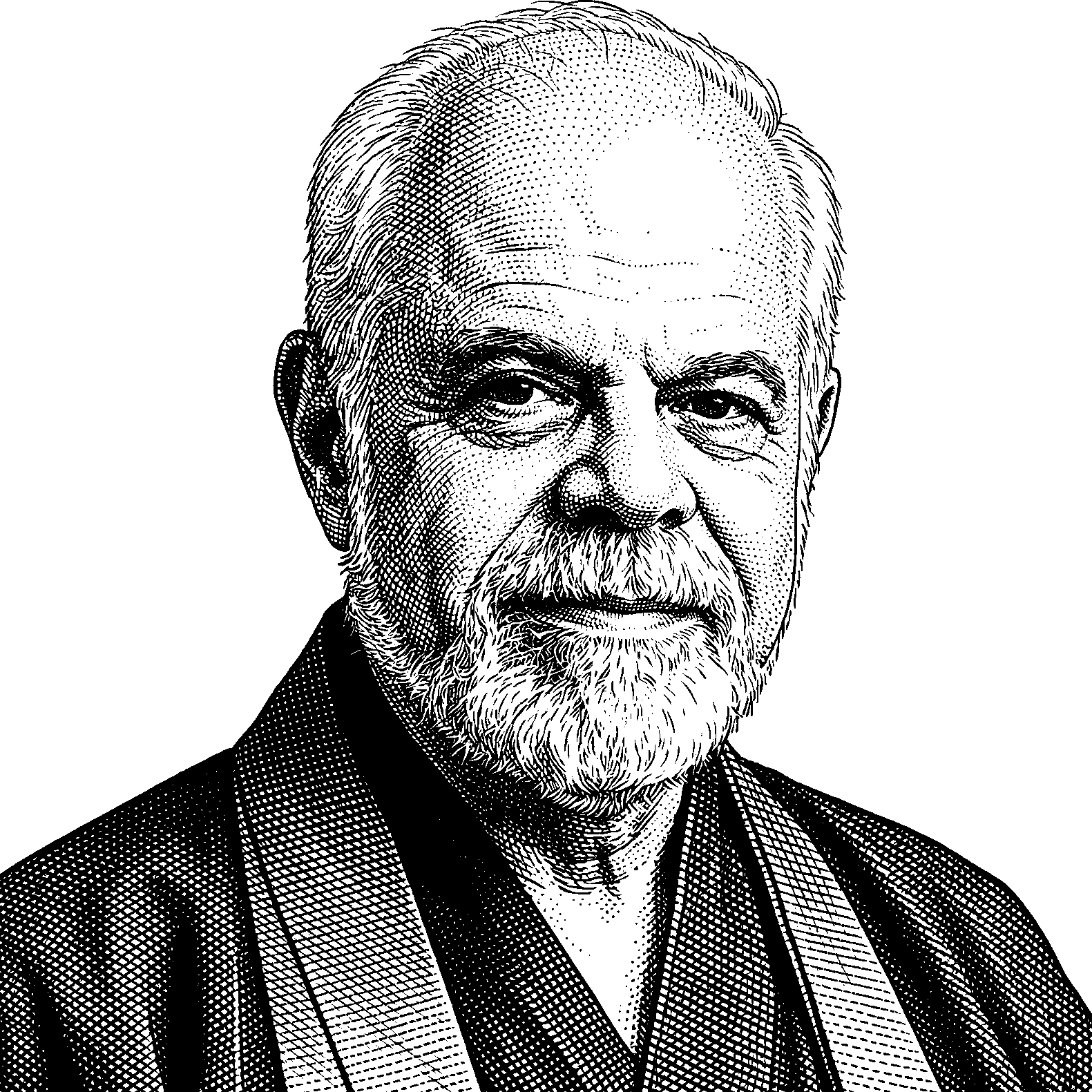
Michael LaTorra is a retired professor of English at New Mexico State University. He is actively involved in the transhumanist community, having previously served on the boards of Humanity Plus (formerly the World Transhumanist Association) and the Institute for Ethics and Emerging Technologies. His academic work explores the intersection of transhumanism, religion, and spirituality. ¶ LaTorra’s publications include the paper “Trans Spirit, Religion, Spirituality, and Transhumanism” in the Journal of Evolution and Technology, and the book A Warrior Blends with Life, A Modern Tao. His presentation at the MTAConf 2014, titled “Where is Heaven?”, delves into the philosophical aspects of transhumanism, exploring the concepts of meliorism, satisficing, and the Buddhist Two Truths doctrine in relation to achieving ultimate reality. ¶ Beyond his academic pursuits, LaTorra is an ordained Zen priest and serves as the abbot of the Zen Center of Las Crucias in New Mexico. He is also a formal devotee of Avatar Adi Da Samraj, further underscoring his deep engagement with spiritual traditions.
Transcript
Speaker 1
Our next speaker will be Mike Latora. Mike is an assistant professor of English at New Mexico State University. He has served on the boards of Humanity Plus, or the World Transhumanist Association as it was formerly known, and the Institute for Ethics and Emerging Technologies. Among his publications are the paper Trans Spirit, Religion, Spirituality, and Transhumanism in the Journal of Evolution and Technology, and the book A Warrior Blends with Life, A Modern Tao. Professor Latora is an ordained Zen priest, abbot of the Zen Center of Las Crucias in New Mexico. and a formal devotee of Avatar Adi Da Samraj. Please welcome Mike.
Michael LaTorra
Good morning. My PowerPoint is going to be coming up here, and I’ve been told that it will be available online as a slide deck. So I will go through some of these slides rather quickly.
Michael LaTorra
The title of my talk is Where is Heaven? For the purpose of my presentation, I’m going to be defining transhumanism. As, first of all, a form of meliarism, the idea of progress leading to an improved world for human effort. And also as a form of satisficing, we are considering alternatives until an acceptability threshold is met. In other words, we want to make things better, but we don’t have some particular ideal in mind.
Michael LaTorra
I’ll also be employing the Buddhist Two Truths doctrine. And this distinguishes a conventional truth of ordinary life from an ultimate truth. The conventional truth can be understood by reason and looking at our own experience. The ultimate truth is more philosophical and abstract and becomes only obvious as truth when the person Actually, engaging in spiritual practice moves to a higher level of understanding.
Michael LaTorra
I’ll also define heaven as the ultimate place. Paradise is defined as a really nice place. So a transhumanist paradise would be possible, but a transhumanist heaven would not be because heaven is reached by other means than the technology that we’ve been employing as transhumanists.
Michael LaTorra
Let’s look at the world, universe. According to Professor Nealegrass Tyson, There were about 100 billion atoms in a single strand of DNA, about 100 billion stars in a typical galaxy, and about 100 billion probable galaxies in the universe that we can see.
Michael LaTorra
But there’s also a multiverse theory that there are many universes. And Professor Andre Lind says that a self-reproducing inflationary universe consisting of different parts exponentially large and uniform because of cosmic inflation Would have each part looking like a separate mini-universe or a pocket universe independent of the other parts of the universe. Professor Lind and his colleague Vitaly Vinchurin calculate that the number of possible universes in this multiverse with different geometrical properties is Hugely large, ten to the tenth to the seventy-seventh power.
Michael LaTorra
Then there’s the ancient mythical cosmos. Stars as lights On a crystal dome, and this individual in a medieval woodcut breaking through that dome to find out that the universe is actually much more complicated than just a dome. As you can see there, level upon level.
Michael LaTorra
I’d like to look at the Buddhist cosmology, and I’ll go through the next few slides pretty quickly. Basically, the traditional Buddhist cosmology divides the cosmos into three broad realms: a sense-sphere realm, a fine-material realm, and an immaterial realm. Each of these realms is subdivided into several subsidiary planes for a total of thirty-one levels.
Michael LaTorra
The sensory realm has eleven planes, including the one we exist on. There are seven better planes and four worse ones. We are at the lowest level of the better planes. Below us is where things get really bad. But above us in this same realm are several better planes. These we might think of as what transhumanism could take us to, or which we could access perhaps in another lifetime, according to the Buddhist theory of rebirth.
Michael LaTorra
Next to the five material realm, this is sixteen planes. And this includes Planes that do not have gross matter at the level that we exist, but a finer level of matter. Denizens of these realms enjoyed greater bliss, power, luminosity, and vitality than do denizens of the sense sphere realm. And these planes now correspond to the first four levels of jhana or bliss meditation as taught by the Buddha.
Michael LaTorra
Then come four immaterial realms. This is mind only. This is the most abstract. Denizens of these four planes enjoy enormous life spans, extending for 20,000, 40,000, 60,000 80,000 great eons, with the term eon never being precisely defined. But we can think of this as subjectively for times that seem to be almost eternal. These four planes correspond to the second group of four blissful jhanas or levels of Buddhist meditation. These planes are named after those four genres: infinite space or boundless space, infinite mind, nothingness, and neither perception nor yet non-perception.
Michael LaTorra
But none of these worlds in the Buddhist cosmos is true heaven in the sense that I’m using that term as the ultimate place. Life in the cosmic world arises due to conditional factors. When those conditions no longer obtain, life ceases. So life experience in the cosmic domain is impermanent, not fully satisfactory, and lacks an essential being.
Michael LaTorra
Bhikkhu Bodhi, who is a Western-born Buddhist monk. describes the situation this way. In the Buddhist cosmology, existence in every realm being the product of a comma, or karma is the Term from Sanskrit that you’ve probably heard of. Kama is the Pali language version, and I’ll just use the Sanskrit karma. Being the product of karma with a finite potency is necessarily impermanent. Beings take rebirth in accordance with their deeds, experience the good or bad results, and then when the generative karma has spent its force They pass away to take rebirth elsewhere, as determined by still another karma that has found the opportunity to ripen. Hence the torments of hell, as well as the bliss of heaven, or what I would call a paradise, no matter how long they may last, are bound to pass.
Michael LaTorra
For this reason, the Buddha does not locate the final goal of his teaching anywhere in the conditional world. He guides those who are still tender to aspire for a heavenly rebirth. and teaches them the lines of conduct that conduce to the fulfilment of their aspirations. But for those whose faculties are mature and who can grasp the unsatisfactory nature of everything conditioned, He urges determined effort to put an end to wandering in samsara, that is the conditional realms, and to reach nibbana, nirvana is this Sanskrit term. Nirvana transcends all planes of being.
Michael LaTorra
Now I’d like to look at the cosmos according to Avatar Adi Da Samraj. Ayid Asamraj was born in 1939 in New York. His given name was Franklin Jones. And after many years of spiritual practice under several different teachers, He realized his own enlightenment and eventually took the spiritual name Adida.
Michael LaTorra
This is one of the most important slides in this whole presentation. Adi Dha describes life as having seven potential stages. The first The first two stages into the third are about childhood, adolescence, and becoming a mature adult human being. The fourth stage, spiritualization, divine communion, is where real religion begins.
Michael LaTorra
When I say real religion, I’m talking about a religion that actually helps people to grow, not merely to believe something that they find comforting or distracting. I’m not, of course, a Mormon, but one of the things I’ve noticed about Mormons and the Mormon Transhumanist Association in particular is that You have a greater foundation in this fourth stage. And as a community, I think Better practices for raising your children through those first and second stages to become mature adults. As you know, in American society today, we have all kinds of problems, and I’m sure the Worming community is not exempt from those, but I think you’re better off than a lot of folks in this regard.
Michael LaTorra
Beyond this fourth stage, there are a couple of more stages of spiritual ascent, which is mystical and in aspect, and that would be a simple way to describe it. And a sixth stage, sometimes called self-realization. Adidas uniquely teaches seventh stage as awakening from all egoic limitations. And this is not a seventh stage that comes after the sixth, as if you were climbing a ladder, but rather an orientation that can be given throughout all the stages. In a spiritual community that practices according to this teaching.
Michael LaTorra
The cosmos, as Adidah describes it, is what he calls a cosmic mandala. This is a series of concentric planes or spheres which can be seen during the death transition or in certain stages of visionary experience.
Michael LaTorra
The red realms of existence or lower than human gross levels. These include the four planes of Deprivation in that Buddhist cosmology, the four lower planes below us.
Michael LaTorra
And we are at the place where the red turns to yellow. The golden yellow plane, human embodiment, and the lower etheric or astral realms. This includes most of those sixteen planes in the Buddhist fine material realm that I discussed previously.
Michael LaTorra
The silvery right is the highest astral realm and corresponds to the upper planes of the Buddhist fine material realm.
Michael LaTorra
The dark blue or black is a transitional zone or empty space between the higher astral planes and the lower subtle realms. You can think of this as entering a room at night when it’s dark before you turn on the light.
Michael LaTorra
The brilliant blue is the subtle planes which correspond to the Buddhist immaterial mind-only realm. Aktar Adida has spoken about the subtle realms as benign places or dimensions of existence where the sense of separate self is hardly noticed. Thus they are places, so-called, of apparently limitless joy and bliss, typically free of fear. Where one is freer to notice and participate in the inherent nature of existence itself, which is self-radiant love-bliss, consciousness, and light. The experience of pervasive and indescribable joy, love, radiance, and awareness is characteristic of the subtle realms. Even in the midst of such potentially magnificent experiences, however, from the perspective of the highest realization, even this most refined state of existence, as full of joy and bliss as it may be, Is still a condition of suffering, of non-realization. It is not nirvana.
Michael LaTorra
At the very center of the cosmic mandala is the clear white radiant core of all light frequencies, which is often manifest as a five-pointed star. This is the portal or gateway. Between the subtle realms and the realm of radiant transcendental being, or the divine domain, what the Buddha called Nirvana. Is the exit from the cosmic domain to what I’m calling true heaven.
Michael LaTorra
Now, I’d like to share with you some first-hand reports of devotees of Adi Dasamraj who, through his grace and spiritual influence and direct instruction, had some experience of these realms. Anne Rogers said, in an instant, without any noticeable transition, there it was, another world. This was a beautiful place and extremely attractive. I was in a room made out of amethyst crystals, yet there was no feeling of sharpness to the scene. It was peaceful and bright and felt very happy and serene. Directly in front of me was a throne made largely out of crystals. Beyond the throne was a window. It felt as if the room were an entry room or foyer into another world. I approached the window and opened it. It was glass with a frame and hinges to open and close. I could see through the window, but I opened it to take a better look at the site behind the throne. It was an earthlike meadow, but of the most beautiful quality. There was an exquisite light that made the colours of the meadow very vibrant, like the light here sometimes after rain. There were flowers of different colours growing in the spring green lawn, and beautiful billowing trees that grew in a line which led up a slope to an inviting forest. The place had the most serene and inviting quality. It had a radiance that is not often felt on this plane.
Michael LaTorra
Connie Mantas had an experience going even beyond that. She said, First there was an explosion of inner sounds, then I felt the layers of the body-mind release and fall away. I was separating out from the physical body and seemed to fly upwards, whirling through dark space at an incredible speed. I was moving toward an overwhelming brilliant light. At one point I recall slipping through a kind of grid as a speck of consciousness. For an instant, I did seem to lose all self-awareness. but throughout the rest of the experience I was aware of the most remarkable clarity. I found that I felt more familiar and at ease travelling without the body than when I was dragging it along, anchored to it by my usual physical body identification. I felt myself to be alive as consciousness, at ease as the witness of mind and attention. At different moments in this cosmic journey, I felt the deep urges of the body mind drawing me back toward embodiment, and I sensed the frustration of having no physical body through which to enact or fulfill desires. This made a stunning impression on me, and I remember feeling how foolish it would be to waste the opportunity of a human lifetime to do this spiritual practice. That could help free me of the binding attachments I had now seen so clearly.
Michael LaTorra
Adi Dha describes his visit to the high place of transition for beings who are in the last stages of embodied existence, about to pass through the star portal to the divine domain. He said it is a place of great souls who are being divinely translated, not by any merit of their own, but because they are attracted by the living divine.
Michael LaTorra
I’m recalling now the Buddhist doctrine of the two truths, of conventional and ultimate. So everything I said in the previous slides was moving from the conventional toward the ultimate, becoming less and less conventional along the way. Now here is Adi Das Amraj speaking the ultimate truth.
Michael LaTorra
You are not consciously a separate entity. even though you may presume yourself to be such an entity through your usual association with experience. Conventionally, you believe that the realm wherein you are one with God is somewhere other than your present circumstance. You believe that the Divine is some one else or other. You think that the Divine is so profound you could not realize God except in a totally different state, circumstance, and dimension than this present one. But God is simply the shining conscious being that is your nature at all times and under all circumstances.
Michael LaTorra
So in conclusion, let me say that heaven or the ultimate place can be realized by spiritual transcendental practice. Paradise, or a circumstance of enhanced human life, can be realized by transhumanist means through science and technology. We need both, transhumanism at the base and transcendence at the apex, moving from conventional improvements to ultimate realization.
Michael LaTorra
Thank you. I have time for a couple of questions, I’m told, if anyone has a question. Yes?
Audience Member
resistance in the the um technology community, the scientific community with this uh you know concept. kind of filter through.
Speaker 1
Can we please repeat the question as well?
Michael LaTorra
Why is there so much resistance in the scientific and technology community to this point of view that I’ve presented here? I would go back to something that Carl said earlier about a linear and nonlinear thinking process. I think that people who are very rational would like to not have the kind of experiences or that thought process inhibits these kind of experiences. I would like to think that we can actually balance and have both. And in my own case, it’s my experience. Thank you.
Michael LaTorra
Thank you.