James Carroll

Portrait of James Carroll

James Carroll is a speaker and thinker focused on the drivers of technological progress and their implications for the future. He presented at the MTAConf 2014, examining the rate of technological change and questioning whether it is linear or exponential. His 2014 presentation sought to temper overly confident singularitarian views, such as those proposed by Raymond Kurzweil, suggesting that an exponential trajectory was uncertain at best.

Building on his previous work, Carroll’s subsequent research has extended the discussion to include additional paradigms for innovation, specifically invention and specialization, trade, and the economics of scale (referred to as the ‘scale’ paradigm). He explores the relationships between these paradigms and population growth, arguing that technology impacts population size by enabling larger populations through advances in food production, reduced epidemics, and lower infant mortality rates.

Carroll’s work considers both the impact of technological progress on society, and the societal factors that drive innovation. He argues that understanding these forces is crucial for assessing the potential for transhumanist visions to be realized, and for navigating the future of humanity in a rapidly changing world.

Videos by James Carroll

Population Size, Technological Innovation, and Mankind's Future
19:30

James Carroll

Population Size, Technological Innovation, and Mankind's Future

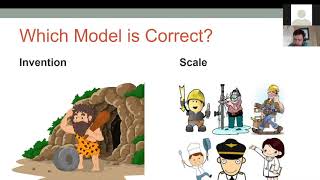
James Carroll examines whether technological progress depends primarily on invention or on population-driven specialization, trade, and economies of scale. Historical evidence from isolated populations in Tasmania and the Andaman Islands suggests that technological regression can occur when population sizes shrink, even when people retain knowledge of advanced techniques. Carroll argues that sustaining exponential technological growth while protecting Earth's environment may require advances in 3D printing, AI, and robotics to decouple innovation from population size—alongside space colonization to expand human numbers without increasing terrestrial population density.

2018 Statistical Report of the Mormon Transhumanist Association
21:37

James Carroll

2018 Statistical Report of the Mormon Transhumanist Association

James Carroll presents the 2018 statistical report for the Mormon Transhumanist Association, revealing 794 total members with 73 voting members. The report analyzes membership trends, website traffic, and social media engagement, noting that interest has shifted from web to social platforms. Carroll also shares results from a survey comparing MTA demographics to Pew's Religious Landscape data, finding that members are predominantly middle-aged, highly educated, male, and politically liberal compared to Mormons in general. He concludes by discussing the organization's need to clarify its purpose—whether to focus on growth or providing services to existing members—and calls for strategies to engage the next generation.

Meaning and the Broken Myth
18:03

James Carroll

Meaning and the Broken Myth

James Carroll examines how meaning and purpose can survive—or be rebuilt after—a faith transition. Drawing on his background in artificial intelligence and Bayesian reasoning, he argues that neither the existence of a Creator nor belief in eternal life inherently produces meaning; rather, meaning emerges from conscious subjective experience and human desires. Carroll suggests that the same axiom underlying Mormonism's "plan of happiness"—that humans are that they might have joy—can provide purpose whether or not one retains literal belief, finding value in the present moment, human connection, and compassionate action.

The End of Religious Anxiety: Towards Religious Universalism
20:17

James Carroll

The End of Religious Anxiety: Towards Religious Universalism

James Carroll’s presentation, “The End of Religious Anxiety: Towards Religious Universalism,” challenges the traditional concept of a wrathful God, particularly as exemplified in Jonathan Edwards’s sermon, “Sinners in the Hands of an Angry God.” Carroll critiques Pascal’s Wager, which argues for belief in God as a risk-averse strategy, pointing out the inherent problem of choosing which religion to embrace. He suggests that a more universalist approach to religion can alleviate the anxiety induced by exclusive doctrines of salvation and damnation, implicitly advocating for a broader, more inclusive spiritual perspective.

What is the Pace of Technological Change?
25:41

James Carroll

What is the Pace of Technological Change?

James Carroll examines the critical debate between linear and exponential technological growth, a question central to transhumanist predictions about the future. He presents arguments from both sides: linearists point to slowing "life impact" of new inventions compared to transformative technologies like indoor plumbing, while exponentialists cite Moore's Law and the combinatorics of technological innovation. Carroll analyzes data on microprocessor speeds, gene sequencing costs, and supercomputer performance, finding mixed evidence. His key conclusion: regardless of what happens after Moore's Law ends around 2025, computing hardware will likely reach human-brain simulation capacity before that deadline—making AI development's trajectory dependent primarily on software advances rather than hardware limitations.

The Evolution of God: What Evolution Says about the Existence and Nature of God
18:48

James Carroll

The Evolution of God: What Evolution Says about the Existence and Nature of God

James Carroll argues that evolution—understood broadly as a search strategy producing complexity through cooperation, specialization, and trade—offers insights into the potential existence and nature of God. Tracing the pattern from RNA molecules forming symbiotic relationships with DNA, to eukaryotic cells, to multicellular organisms, to human collective intelligence, he identifies a consistent mechanism: simpler entities merging into more complex collectives. Carroll suggests this trajectory points toward future beings that are “one yet separate, separate yet one”—a description resonant with trinitarian theology. Rather than a supernatural creator outside nature, evolution predicts a God emerging within nature through the same processes that produced us.

Epiphenomenalism, the Problem with Property Dualism
14:42

James Carroll

Epiphenomenalism, the Problem with Property Dualism

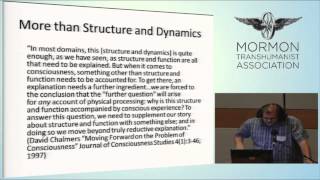
James Carroll critiques David Chalmers's property dualism as a solution to the hard problem of consciousness. Chalmers proposes that experience is a fundamental feature of the world requiring new psychophysical laws beyond physics, but Carroll argues this view is fatally epiphenomenal—the experiences it describes cannot causally influence our claims, beliefs, or memories about having experiences. Since what we report experiencing must involve physical processes like moving neurons, any "experience" that doesn't causally connect to behavior isn't the experience we actually care about explaining. Carroll concludes that while property dualism cannot be disproven, it's irrelevant to questions about AI consciousness, animal welfare, and mind uploading.