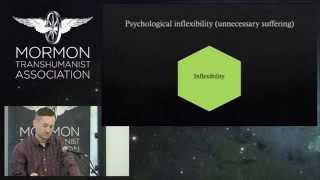
Jordan Harmon

Portrait of Jordan Harmon

Jordan Harmon is a psychotherapist and social worker who considers himself an “accidental transhumanist.” His journey into transhumanism began after encountering the Mormon Transhumanist Association (MTA) through a podcast and subsequent interactions with members. Initially drawn by a misunderstanding—thinking it was the “Mormon Transpersonal Association” due to his interest in transpersonal psychotherapy and its implications for spiritual growth—Harmon initially approached transhumanism with some hesitation.

However, after engaging with the ideas of transhumanists like Lincoln Cannon and Carl Youngblood, Harmon became increasingly interested in the movement. His work now explores the intersection of psychology and transhumanism, particularly focusing on our relationship to pain and problem-solving. He delineates two types of problem solving: the primitive, reactive response rooted in evolutionary survival, and the evolved, meaning-making response of the prefrontal cortex, which can sometimes exacerbate emotional and psychological pain.

At the MTAConf 2015, Harmon discussed the “problem of problem solving,” examining how our evolved capacity for rational thought and planning can inadvertently trap us in our minds, hindering our ability to live fully. He also touched upon the internal experience, characterized by a vast array of thoughts, emotions, urges, and moral judgments, and how these elements interact to shape our perceptions and actions, highlighting persistent challenges in self-governance and interpersonal relationships.
Videos by Jordan Harmon

Deep Ecology v. Transhumanism
47:35

Jordan Harmon

Deep Ecology v. Transhumanism

This presentation reframes the relationship between deep ecology and transhumanism as a dialectical pairing rather than an adversarial opposition, drawing on the speaker’s professional background in psychotherapy where acceptance and change strategies work together. While deep ecologists tend to view technology worship as a root problem and emphasize the inherent worth of all living systems, transhumanists place faith in science and technology to solve problems of human and nonhuman flourishing. The speaker proposes that both movements share concern for well-being beyond anthropocentrism, and suggests that transhumanists might benefit from contemplative acceptance practices—not as resignation, but as a foundation from which more sustainable change can emerge.

Redeeming Death A Skeptical Approach to Living Forever
18:40

Jordan Harmon

Redeeming Death A Skeptical Approach to Living Forever

A therapist who practices dialectical behavioral therapy, the speaker examines his own resistance to technological resurrection despite being drawn to Mormon transhumanism. He applies dialectical thinking to death itself, proposing that death might be both monster and friend—something to be overcome in certain contexts while also serving important functions. Drawing on acceptance and commitment therapy, Buddhist philosophy, and the Gaia hypothesis, he suggests that the real problem may not be death itself but our fear of it and our clinging to narrow definitions of life and self.

The problem of problem solving
21:04

Jordan Harmon

The problem of problem solving

Jordan Harmon explores why the human capacity for problem-solving—so effective for external challenges—often compounds psychological suffering. Drawing on relational frame theory and acceptance and commitment therapy (ACT), he distinguishes between the primitive fight-or-flight response and the prefrontal cortex's tendency to ruminate on emotional pain. Harmon outlines six processes of psychological flexibility—defusion, acceptance, present-moment awareness, values clarification, committed action, and self-as-context—and speculates on how these principles might apply at macro scales to technology, religion, and social systems.