Seek Ye First the Kingdom of God
Ben Blair argues that strong communities are byproducts of pursuing worthy aims rather than ends in themselves. He critiques both religious institutions that equate themselves with the kingdom of God and secular groups that make community their primary goal, suggesting that both miss the driving force of shared purpose. Drawing on examples from the D-Day invasion to the Mormon pioneers, Blair proposes that the Mormon Transhumanist Association’s aspirational vision—working collaboratively toward becoming gods who lift each other up—provides the kind of "work cut out for us" that sustains robust, long-lasting communities.
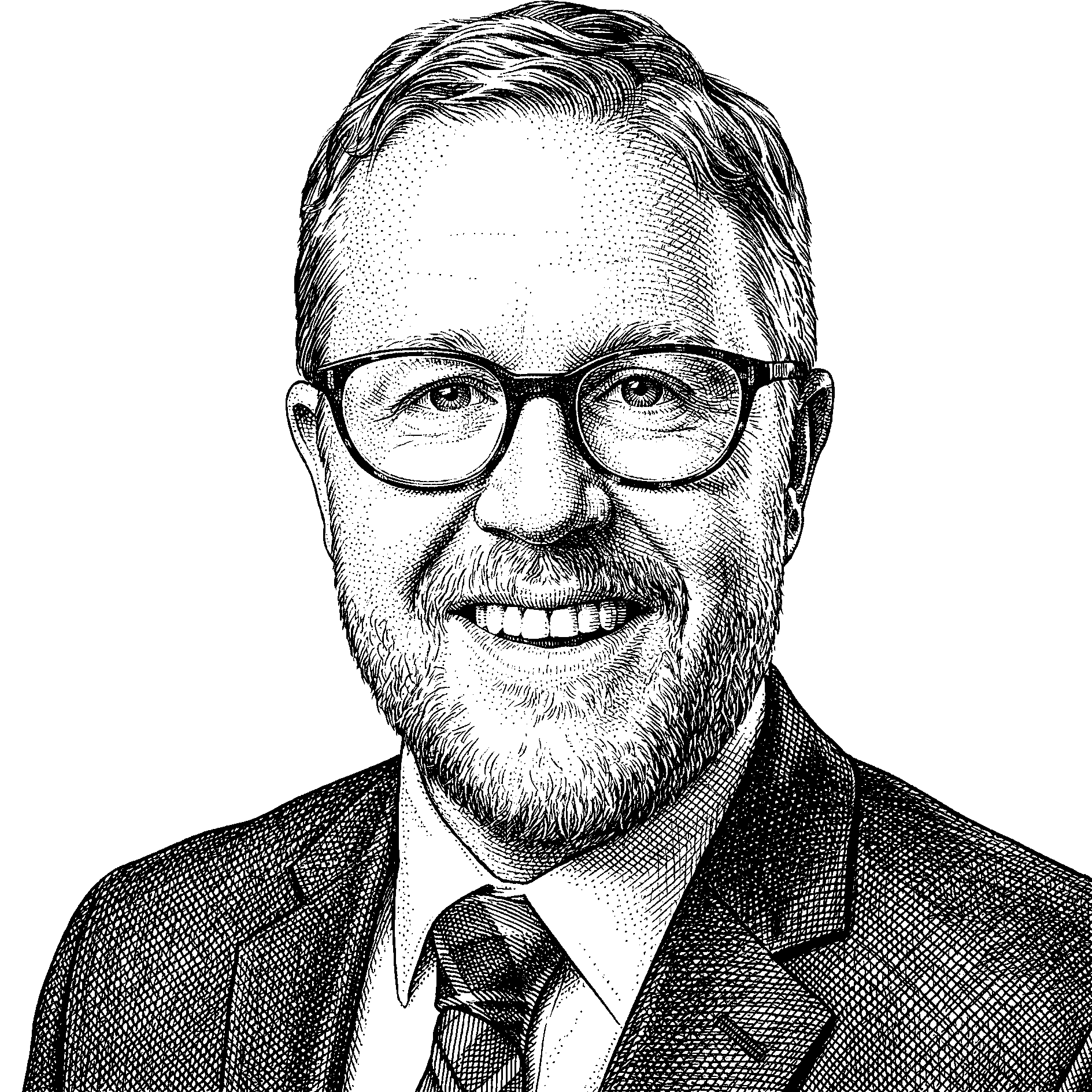
Ben Blair holds a PhD in philosophy and education from Teachers College, Columbia University. He is the co-founder of Newlane University—a platform focused on deinstitutionalizing education. ¶ An active member of the Church of Jesus Christ of Latter-day Saints, Blair’s work and perspective explore the intersection of religious community and secular ideals. He is particularly interested in how religious and post-religious communities can work towards shared goals, and he questions the equation of any particular organization with the broader concept of the 'kingdom of God'. ¶ Blair, along with his wife, Gabrielle Blair, resides in France and they are the parents of six children. He presented at Sunstone West and is an attendee and speaker at Mormon Transhumanist Association conferences, where he explores the philosophical implications of faith, community, and progress.
Transcript
Speaker 1
It’s my great pleasure to introduce Ben Blair, and Ben has a very Loyal and supportive family, who happens to be present as well, many members of his family, and they’re a wonder to behold. Ben Blair holds a PhD in philosophy and education from Teachers College, Columbia University, and is a co-founder Of teacher. co. That’s T-E-A-C-H-U-R. C-O. Please visit the website as soon as you can. A platform to deinstitutionalize education. That sounds threatening. He and his wife, Gabrielle Blair, are the parents of six children and live in Oakland, California. Also want to thank Ben for receiving us me as a guest the other day when I presented at Sunstone West. Really grateful for our friendship. So, Ben, thanks for coming.
Ben Blair
My family, a lot of my family is here. It’s also because there’s my niece is having a gender reveal party. A gender reveal party for her child just downstairs. So I’m maybe just across, so I’m maybe a bit concerned. I may be a bit concerned that some family members are confused about the two gatherings and may show up here crossed in dress.
Ben Blair
In Matthew we read, But seek ye first the kingdom of God and his righteousness, and all these things will be added unto you. In the wake of growing distaste for religion in the US and elsewhere, there seems to be a trend to build post-religious or secular communities. These secular groups seem to aim to replicate the goods of religious community, but without the baggage of religious dogma. This trend offers an occasion for religious and post-religious communities to consider what ideals they should be working toward and how they emerge and are best sustained. Hopefully this to me it felt like this fits in well with several of the previous talks.
Ben Blair
I’m an active Mormon. I grew up in the Mormon church, and I loved it. I was frequently told, and I believed, that through my church activity, I was doing the work of God. I deeply valued this. This understanding made all interactions in church service and my entire orientation toward the world as a Mormon at once meaningful, crucial, and holy.
Ben Blair
At some point my perspective changed. Perhaps I lost sight, perhaps I awoke. But at any rate it was difficult to see how performing my church responsibilities, doing my callings, doing the tasks I was asked to do was building the kingdom of God. After all, the kingdom of God has meaning outside of and independent of any church or organization, regardless of any group’s claim to the contrary. The kingdom of God is an ideal we work toward. Equating the kingdom of God with any organization is not how scriptures use the phrase, and as importantly, that’s not what the words mean to an outsider of an organization. Though it was clear I was strengthening the church and my affiliation with the church, it was difficult to see how that translated to the kingdom of God in any way that could be communicated to an outsider.
Ben Blair
As I reflect on my experience growing up in Mormonism, I can discern two related environments that supported and challenged me to mature in responsible ways. On the one hand, there was the church community, the actual specific people of varying ages and backgrounds that I interfaced with frequently and in a wide range of contexts. On the other hand, there was the kingdom of God, the ideal that underscored all interactions and efforts and transformed these into sacred meetings with eternal significance. So the community and the kingdom.
Ben Blair
And we’re familiar enough with the goods and benefits of religious community, even while we recognize the risks It’s an open question whether or what portion of these benefits can be replicated in contemporary secular communities. But these secular communities are doing their part to test this. Part of the reason this can be an open question is that a key is that a key strength of religious communities, at least based on my experience, is that undergirding everything is the conviction that all of this is holy work, with eternal significance. The Sunday school lessons, the mechanic referrals, and the chit-chat are all part of building the kingdom of God. In fact, in Mormonism, as with other religious organizations, the kingdom of God is often used as just another name for the church. And building the kingdom of God is simply participating to any degree in church activities. My experience reflects this, and we can get this idea with not so subtle church statements like this. The kingdom of God on earth is the Church of Jesus Christ of Latter-day Saints. The purpose of the church is to prepare its members to live forever in the celestial kingdom or kingdom of heaven.
Ben Blair
Importantly, perhaps tragically, identifying the institution of the Church with the Kingdom of God has the effect of removing any critique on the Church by the ideal of this kingdom. This effectively takes the wind out of the sails of a church and can transform community members intent on building the kingdom of God into institutional pawns. A religion could be an institution always seeking the kingdom of God, but this is quite different from being the kingdom of God. Moreover, this equivocation has serious consequences, including disaffection among members when they believe a church isn’t what it claimed to be. This equivocation can stand for a host of such disappointments, attested to by disaffected members and former members of lots of religions
Ben Blair
For founders of these post-religious communities, if their frustration was that, in their former religions, they loved the community, but saw in some teachings and practices the community misappropriated for the institution’s sake. To resist and counter this, they have instead made the community itself the central object, creating community for community’s sake.
Ben Blair
But I want to return to my experience and suggest that some of the power of religious communities is tied to something like a conviction that they are doing the work of God. Understandably, this feels like religious baggage, and I recognize that this can be a slippery slope back to the religious dogmas, but it doesn’t need to. Naturally, omitting this conviction makes sense from a post-religious perspective. But this omission is not without consequences. First, as I have noted, a significant part of the enthusiasm for my participation came from my belief that I was doing God’s work. As I reflect on some of history’s most tightly knit communities that lasted, such as the Children of Israel and the Mormon saints crossing the plains, I discern a similar source for their devotion.
Ben Blair
Second, and more importantly for my purposes, this omission skirts a critique from the ideal of the kingdom of God A central aspect of this critique is that a community seeking the kingdom of God has its work cut out for it. Having work cut out for you doesn’t mean someone tells you what to do, though it can include that. But having your work cut out for you means that you’re interpreting a situation as demanding or calling calling for a response. So recognizing that there’s a bit of food on your chin, or that your shoelace is untied, or that your boat is sinking are all examples of having your work cut out for you.
Ben Blair
And a central aspect of this critique that a community is seeking the kingdom of God must project into the future and map as best it can the trajectory toward its conception of God. This work toward the kingdom of God is prospective. It’s not a look back at history to locate God, but a future aspiration to present a worthy offering to God or to become God’s.
Ben Blair
And here groups like the MTA play an important role. The MTA looks forward to God as at least a future fulfillment of human desires and values. And the MTA appreciates efforts like imagining, hypothesizing, and mapping the trajectory of its activities toward a conception of God and acting accordingly. To seek the kingdom of God from this perspective is to work creatively and compassionately with tools like science, technology, and religion to enhance and extend the quality of life of all humans until we become gods. Talk about having your work cut out for you.
Ben Blair
I take to have one’s work cut out for you as a primary driver for the strength of community. This challenges the position that community can be reduced to interacting in a range of contexts or about common values and beliefs. Having your work cut out for you can guide activities and provide feedback. consider participants of the D-Day invasion. They were a band of brothers not because they rowed a boat together across the Channel and had similar training and shared conversations, pictures, and meals but because they were bound together in a noble cause. And they were moving forward in that cause.
Ben Blair
As I read them, post religious communities don’t have their work cut out for them or the work is just contained in any community participation, or it’s contained in offering a sort of fellowship to members. The aim and end is fostering community. They may take on noble causes, but that work isn’t cut out for them. On the other hand, religious communities do claim their work is cut out for them, and it’s unimaginably important. But the work often amounts to the same thing as the secular counterparts. Just any community participation. And witnesses that this participation is unimaginably important in bringing about the desired aims fall flat with time if we don’t see the invasion line move. move east toward and ultimately across the coast of Normandy. I’m not arguing for the need to do some great thing, but to be able to see over time progress tied to our efforts toward worthy aims.
Ben Blair
We can plot the alternatives on an important work cut out for us matrix. In coordinate A, the work is not important and not cut out for us. This would be a group of people aimlessly frolicking in a boat off the coast of Normandy. Coordinate B would be a group of people asked to paddle five hundred meters north just for kicks, or for who knows why. Coordinate C would be a group of people playing in a boat who accidentally find an Enigma machine. and Coordinate D would be participants in the D Day invasion. All these groups would have shared experiences, but it’s easy to see which would foster the strongest, longest lasting community.
Ben Blair
And we need to address a third category represented by this next matrix, and this is work that is feigned important, but we can’t validate the importance of the work. This coordinate would be people playing in a boat who are assured that the universe hangs in the balance of them doing whatever they happen to be doing. And the other the next coordinate would be people asked to paddle 500 meters north and assured that the universe hangs in the balance of their doing so. This could be like Mr. Mayagi, if he never told Danielson why wax on, wax off, or sanding the floor was important.
Ben Blair
And I’ve drawn out these implications in another colorful chart, and this is based on in-depth thoroughgoing daydreaming. So these are comparing the strength and sustainability as well as the risk of exploitation and disaffection. The strength correlates with having our work cut out for us. And if it’s important, then it can be if it’s both of those, then it’s sustainable. But we also need to be mindful of the risk of disaffection and resentment. I’m suggesting that the strength and sustainability of the community is tied to participating in important work toward a worthy aim, and the highest risk of resentment is participation in work toward an aim that is not communicably important.
Ben Blair
To put this in terms of the aims of these religious and post-religious groups, I’ll take this a step further and propose that the strength of community Is a byproduct of cooperative work toward aims that, according to our best efforts, align with a God worth worshiping, whether we believe that God currently exists or not. or in the context of Mormonism or the MTA, co operative work toward a God worthy of our aspirations. For the strongest communities, then, community is not the aim, but a by product.
Ben Blair
The engine of community from this perspective could be modeled like this. We begin with a consideration of whether our aim, God, is worthy of our aspirations. And then ask whether our collaborative efforts are closing the gap between us and God. If we find our God isn’t worthy of our aspirations, then we need to seek further light and knowledge. And if we find that our collaborative efforts aren’t closing the gap between us and God, again, we need to seek further light and knowledge.
Ben Blair
Insofar as God is the ultimate human aspiration, this work is important. We can’t just leave it to individuals to do on their own. That’s circumstantial. We need institutions and groups fixed to this aim as the work cut out for them. Religion has carried this banner for centuries. Sure, it has dropped it at times, but it’s a worthy banner that all of humanity can embrace, religious or otherwise.
Ben Blair
Now I turn from the kingdom of God as the aim and community as the byproduct to criticisms of religious and post-religious communities. While I have some surface criticisms of the tendencies of these communities gone wrong, my more serious concern is that if we were in the world of the Hunger Games, we’re in the capital. chasing after, on the one hand, the best package of benefits, prestige, and remarkable experiences or, on the other, chasing sacred rituals and words, or affirmation from leaders. But in either case, from any outside perspective, we’re missing the only fact that matters, that our life is built on the back of systematic oppression, or, in short, we’re neglecting God’s work.
Ben Blair
Here’s where I think the MTA offers a unique position that is at once aligned with the aim of building the kingdom of God, but welcoming to secular and religious approaches. The Mormon Transhumanist Association stands for the proposition that we should learn to become gods, and not just any kind of God, not the God that would raise itself above others, but rather the God that would raise each other together. We should learn to become Christs, Saviors for each other, consolers and healers as exemplified and invited by Jesus.
Ben Blair
Conceiving community as a byproduct of pursuing work aligned with God is a permanently open challenge. It can never be reduced to whatever work we do in Institution X. It’s not a tautology. Within religion strengthening the Church and building the Kingdom of God can be at odds. This is an important and productive tension. It can offer a powerful critique of religious practice, but when we equate the church with the kingdom, this tension disappears. For post-religious communities, there is no tension, and hence no sting in such statements, because they avoid stepping into the realm where their work is or should be relevant to the kingdom of God, and they deem this a benefit. but they lose a powerful critique and bond.
Ben Blair
So the trouble is that neither religious nor post-religious communities are open to this critique, though both could use it to criticize the other. The religious would say, ha, well, we are the kingdom of God, but that’s a great critique on our seculus, on the secular folk. And the post-religious. Well, we left that realm a while ago, but it’s a great critique of those religious, self-righteous religious folks.
Ben Blair
For both religious and post-religious communities. Work seeking the kingdom of God offers a link, if not a bond. This work could lay to rest suspicions that either community has the moral high ground. They’re just more or less effective at performing the work. The criteria are these. A robust community has its work cut out for it. And it must be big enough work to sustain lifelong devotion, and in our age, to sustain transparency. and even likely revelations that we were mistaken about what our work was or should be, or how effective we have been at executing the work.
Ben Blair
What would this work look like? I’ll ask it another way. What work could we do that would move us toward the greatest visions and projections of humanity? And how can we respond to critiques that we may be the capital in the Hunger Games? It’s an open question. I would suggest it includes cultivating broadened compassion and creativity to more fully take on evil and death, with the aim to eliminate them through means consonant with Christ. We should be able to make a good case for the proportion of time and effort we spend allegedly working toward the kingdom of God, and that kingdom should reflect a communicable kingdom of a God worthy of our aspirations.
Ben Blair
So what are the prospects of community? If something like D-Day if something like the D-Day Invasion is a good standard, collaborative effort toward what we deem to be a noble cause and we can recognize progress and failure, the prospects for community today are stronger than they ever have been.
Ben Blair
This is so because if we view community as a byproduct of collaborative collaboratively seeking and building the kingdom of God, or aspiring to become God’s, we can better judge our conception of God. The work cut out for us is relatively clear at least compared to past stages. We can monitor the effects of our efforts. Better, so we have relatively straightforward means to assess whether our efforts are tending toward the desired outcomes or not. In short, we can more efficiently run the engine of community. In fact, as our technological, moral, and physical horizons expand, this work becomes increasingly measurable. And the gap between earth and the kingdom of God, or humanity and God, can be seen as measurably closing.
Ben Blair
Certainly, until we become gods, this work will be filled with numerous scientific discoveries, transcendent surprises, Technological breakthroughs, and an abundance of grace. When we completely fill the gap, the kingdom of God will be realized. Then it will have filled its purpose as an ideal and as a critique of our beliefs and efforts. And if we haven’t realized before, we will then that that is the worthy earth, kingdom, aim, community, race, sex, humanity, post humanity, science technology, art, religion and post religion we’ve been working toward all along.
Ben Blair
Thank you.