Strangleholds of School and the Path to Decentralized Education
Ben Blair, co-founder of New Lane University, argues that traditional higher education holds students in a "stranglehold" through control of cost, scheduling, geography, and student records. He proposes a decentralized model where educational pathways—built from discrete learning objectives—can be created, improved, and verified by experts worldwide without requiring institutional intermediaries. Blair describes how New Lane offers college degrees for $1,500 using open-source resources, self-assessment, and oral examinations conducted via video conference. He envisions a future where curriculum continuously improves through expert competition, instruction is optimized at the learning-objective level, and students own their own educational records.
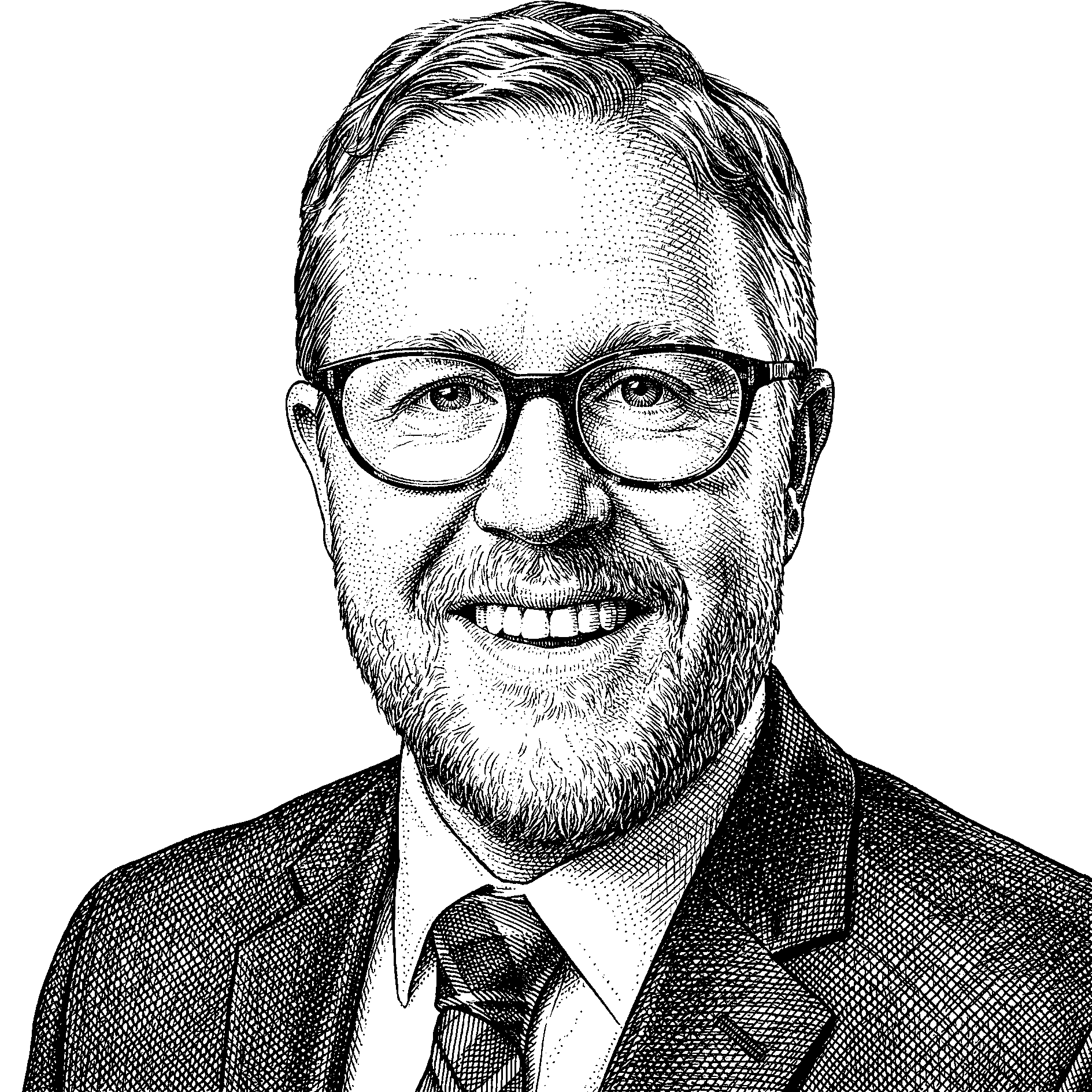
Ben Blair holds a PhD in philosophy and education from Teachers College, Columbia University. He is the co-founder of Newlane University—a platform focused on deinstitutionalizing education. ¶ An active member of the Church of Jesus Christ of Latter-day Saints, Blair’s work and perspective explore the intersection of religious community and secular ideals. He is particularly interested in how religious and post-religious communities can work towards shared goals, and he questions the equation of any particular organization with the broader concept of the 'kingdom of God'. ¶ Blair, along with his wife, Gabrielle Blair, resides in France and they are the parents of six children. He presented at Sunstone West and is an attendee and speaker at Mormon Transhumanist Association conferences, where he explores the philosophical implications of faith, community, and progress.
Transcript
Speaker 1
Ben Blair is a husband and father and lives with his family in Normandy, France. He’s about tied for the person who came the farthest to join the conference today. Ben is co founder and president of New Lane University, an online university mission driven to deliver quality higher education accessible to anyone on earth. New Lane is designed to facilitate and leverage decentralized curriculum development with distributed attribution. Ben holds a PhD in philosophy and education from Columbia University. Ben Blair.
Speaker 2
So a brief summary of New Lane.
Ben Blair
New Lane offers a college degree for $1,500. We currently offer an associate degree and a bachelor’s degree in philosophy. We had our first graduate in the philosophy program in 2020, and this graduate has since completed a master’s degree from the University of Nottingham and has been accepted to a doctoral program At the London School of Theology. We’re very proud. We had our second graduate, this one with an associate degree in 2021, and they’re continuing with our bachelor’s in philosophy. Our price point puts our degree within the reach of many people who would otherwise be blocked from university education, which is thrilling for us, but I’m even more excited about our overall model.
Ben Blair
When I talk about New Lane, I don’t usually start with a scripture, but since this is the Mormon Transhumanist Association, I think it may be fitting to start with a Mormon scripture. As we read in the Doctrine and Covenants, the glory of God is intelligence, or in other words, light and truth. In order for this scripture to connect with us and not just be a truism, intelligence, light, and truth must be accessible to us, to everyone.
Ben Blair
Behold, the university, the bastion of knowledge, intelligence, light, and truth. How grateful we should be for these magnificent institutions. If you haven’t done so recently, I invite you, as I did yesterday, to go visit a university campus. There are a few not too far from here. and bask in its glory. Picture in your mind the easy access to knowledge and expertise and education that is available there. What a university can offer is stunning and beautiful. As a society, we are indebted to these amazing institutions for what they have done and continue to do and enable. Universities are sacred spaces Inasmuch as they are discovering and making knowledge accessible to others, they are enacting the glory of God.
Ben Blair
Now I’ll move from the big picture of the university to look up close at the core offering. I submit that one of the greatest untapped values is knowledge of educational pathways. What’s an educational pathway? Well, if I ask what are the stars in the Orion constellation, maybe you know the answer. If not, you can quickly find it. But if the question is, how do I become an astronomer? This is a much bigger question with much more value at stake. With a question like this, now we’re talking about an educational pathway. And for these questions, we’re dependent on educational institutions like colleges and universities to provide and verify these. You can think of these pathways as courses or a degree.
Ben Blair
Importantly and essentially because these institutions can provide and verify such pathways, these colleges and universities hold an inordinate amount of power and control. There may be competition between institutions, but the deal is you sign up for an institution and it controls the terms, cost, offerings, schedule, location, records, etc. These are all designed for the convenience and maintenance of the institution. Once enrolled, the college or university is a de facto monopoly. You can try to violate the terms, but then you don’t get a degree. These institutions hold all the power. As a student, you’re at their mercy. As an expert or professor, it controls the terms of your contract, where you live, your basic schedule, your course assignments. In short, these institutions have us in a stranglehold.
Ben Blair
I recognize stranglehold isn’t a friendly term. To be clear, educational institutions aren’t evil. Well, some may be. But their strangleholds aren’t the result of evil scheming. For the most part, these strangleholds were just the result of trying to do something different with different people at a different time with different resources. The world’s knowledge base wasn’t always widely available, and it wasn’t accessible nearly anywhere to nearly anyone. There were limited seats in a classroom Professors who had the knowledge lived in certain places and could only teach and reach students at certain times. Research libraries were only available in certain places. There were meaningful geographic constraints.
Ben Blair
But now we’re at a crossroads. Many of the determining factors for how universities are structured have changed. For many people, the status quo isn’t working. Or is acutely painful, and we have also recently caught a glimpse behind the curtain with the switch to online school, where one of these key constraints, geography, suddenly dissolved.
Ben Blair
So why isn’t the status quo working? Or what are these pains or results of the stranglehold? I’ll start with the most acute. The average cost of a four year degree in the U. S. is $120,000. Up until recently, we just unquestioningly accepted whatever tuition costs were at any university. When a couple has a baby and they imagine that child going to college in 20 years, they start an intense savings plan. Because you can’t just put aside a bit of extra cash a year or two in advance for a price tag like this. But this big cost has real consequences. People start out adult life strapped in debt. Or parents are forced to take out a mortgage on their home, or in other ways, make a major sacrifice for their child’s school. People who earn a good income can’t buy a home because of their student loans. We haven’t really come to terms with the burden of this cost on individuals and society.
Ben Blair
But though the cost is maybe the most acute, it isn’t the only constraint. Schools only hold courses at certain times of day, certain times of the year. If the time of day or year doesn’t work for you, you’re out of luck. This has real consequences. Just think about the casualness we accept of telling a student they have to wait a year to graduate because a certain course is only taught in the fall. We’re telling people to put their life on hold because of institutional scheduling.
Ben Blair
There’s also an issue of student records or a transcript. This is your personal educational record. like a medical record, but documenting the courses you took and what grades you received. I’ll talk about some shortcomings of student records in a bit. But I wanted to highlight that we have just accepted that this can be withheld if you have a library fine or a parking ticket. These are factors that are unrelated to your education and what this record represents.
Ben Blair
A few years ago, I would have put geography higher on this list, but because of what we’ve experienced in the last two years, we’ve seen this criterion dramatically shift. For a long time, we’ve just accepted that school could only take place at a certain geographic location, until over the last two years, or it wasn’t going to be a quality education. Until over the last two years we saw that it could take place anywhere. The major hurdle, this major hurdle just dissolved overnight.
Ben Blair
And the strangleholds don’t just affect students. Professors are also at the mercy of the institution. If you’re fortunate to get hired as a professor You’ll need to move to the city where the university is based. You’ll need to teach the courses the institution needs you to teach and do all the tasks related to that. If you want to try another route, like make your own course for Skillshare or some other forum, you can, but the barriers to entry are high.
Ben Blair
And beyond the strangleholds, because of an imbalance of power and control, it’s easy for the institutions to build path dependence. Some of the consequences of this are that it doesn’t function as well as it could, and it doesn’t improve as efficiently as it could. Let me walk you through some of these path dependencies.
Ben Blair
Curriculum is siloed. Introduction to philosophy at Campus One can look very different from what it looks like at Campus II. Professor Clark may emphasize Erasmus because that’s who she’s researching, while Professor Spencer may skip Erasmus altogether. Because the courses are siloed, and what is taught is more dependent on what has been taught in the past, or how the professor how this professor was taught, than on what should be taught. It may be a fantastic course, but if so, it is something like the luck of a draw.
Ben Blair
As far as instruction, professors who are working on their publications in niche areas of a field may not be the best instructors for introductory courses. And there’s not much incentive to improve instruction, especially past a certain level. Since professors teaching the same courses are siloed Instruction doesn’t evolve efficiently. Improvements, if there are any, are typically in a single classroom or campus.
Ben Blair
Assessments may or may not be rigorous, and there aren’t significant incentives to improve. More often than not, they’re a reflection of what is convenient or the professor’s preferences.
Ben Blair
Our educational records are not very informative. They list the courses you took and the grade you got. But what does a B plus in Introduction to Sociology mean? Records are also notoriously difficult to transfer between institutions. Even though we can see significant ways we can improve in all these areas, yet we accept this situation because this is what we’re accustomed to. It’s been difficult to imagine an alternative. And even when we can imagine an alternative because of the imbalance of power, it’s really difficult to affect change.
Ben Blair
So let’s return to the basic offering of these institutions. Remember, for questions like how do I become an astronomer, we’re talking about an educational pathway. And for these questions, we’re still dependent on educational institutions to provide and verify these. but we don’t need to be. After all, an educational pathway is formed when an expert organizes and orders what discrete information must be mastered. This requires expertise, not an institution. And let me dive a little deeper on this because this has some really profound implications.
Ben Blair
If we consider a course like Introduction to Biology, an educational pathway, The discrete information that an expert organizes are learning objectives, or intended learning outcomes. A course is ultimately a list of learning outcomes. For that matter, so is a degree. For a course like Introduction to Biology, learning objectives might include something like explain the basic structure of atoms and molecules. The course may include a lot of objectives, but in order to be meaningful, each objective needs to be distinct. So an educational pathway is made up of a series of discrete learning objectives.
Ben Blair
These pathways are formed by experts. We’ve trusted these institutions for the pathways because they conveniently house experts. Expertise, and they can securely verify and store educational records. But we can find expertise outside of these institutions. And current technology lets us now match or surpass their security in verifying and storing records. We can find this expertise across the globe. And now we can engage securely no matter where we are. You might say the world is our campus.
Ben Blair
Like we’ve seen through many examples today, what used to only be possible through the intermediary of powerful institutions Is now possible in a decentralized way. And once we can match the key tasks the institution carries out but in a decentralized way, a world of possibility opens. We can escape some of the old path dependencies and can suddenly optimize for things that were really difficult to optimize for in siloed institutions.
Ben Blair
We can optimize for continual improvement in curriculum. We can update learning objectives as needs are identified. Experts can contribute to the curriculum And they can just improve a single objective, or a handful of objectives, rather than a full course. Maybe you’re an expert on Plato’s Republic. You can just focus on objectives related to that, and make them the very best. Learning objectives can be better and better attuned to the structure of a discipline as experts compete on curricular design.
Ben Blair
Imagine competition for the best instruction. Can you explain photosynthesis better than others? You can be an educational publisher. Again, you don’t need to do a full course. A single objective is enough.
Ben Blair
We can optimize for improved student experience. They benefit from better curriculum and better instruction. They can also circumvent the exorbitant cost, scheduling and geographical constraints. And they control their record, and their record is informative And transferable.
Ben Blair
Experts benefit from more flexibility in their schedule, geography, and in choosing what they want to work on. They can develop, review, or host assessments. They can articulate or refine curricular objectives. or contribute better instruction at the objective level.
Ben Blair
I expect that many of the improvements will emerge as we learn to pursue and complete educational pathways unburdened by these institutions. To ground this presentation on what we’re currently doing, I’m just going to walk through how New Lane works now to give you a taste for our efforts in these directions.
Ben Blair
Here’s a sample objective from Introduction to Philosophy. The objective is summarize how Western philosophy emerged and developed in ancient Greece. This is a typical objective for an Intro to Philosophy course. It’s easy to find great resources for this objective. Here are a couple YouTube videos. One is from Crash Course, and another is one I made. A student would work through these resources, and when they were ready, they self-assess mastery of that objective.
Ben Blair
After they self-assess mastery, they take a computer scored exam that tests them on every objective. To pass the course, students schedule and meet up at a convenient time for them in an online video conference with a professor. who conducts a 20 to 40 minute oral exam. The professor first verifies the student’s ID by reviewing a government ID and a string of photos taken of the student. The professor also takes a photo of the student and adds it to the string of photos. The professor’s role is to verify that the student has mastered all the goals and objectives of the course or not yet. The professor asks open-ended questions and spot checks and ultimately makes the judgment on whether the student has mastered the content, or again, not yet. Student can be anywhere, and the professor can be anywhere. When a student completes a course, this is time stamped, verified by the professor, and contains documentation of all the course goals and objectives the student has mastered.
Ben Blair
This is how we currently work. We’re centralized at the moment, but we are working toward a decentralized version. We’re working now to encode the standards and protocols so when we decentralize, we’ve worked out the kinks and can scale.
Ben Blair
This is a rough token model to point in the direction of further decentralization in the future. You can see how we incentivize continual improvement in curriculum and instruction, what we’re calling content. And rewards. We reward students with better education, experts who improve the content, and token holders who state good content as its quality is proven with more coins.
Ben Blair
Though I sometimes paint institutions of higher education in a negative light, we are all indebted to these magnificent institutions for preserving, teaching, and expanding the great corpus Of human knowledge that has enabled us in many ways to build a better world. These institutions will continue to play an important role in shepherding and enabling new classes of immature people through important learning, training, and life lessons. And they will continue to expand our knowledge and understanding. And though we are indebted to these institutions for our great heritage of learning, knowledge, and skill, we are no longer dependent on them to obtain these.
Ben Blair
I began with a scripture, and I’ll end with a manifesto. Early on in the life of New Lane, we wrote a manifesto that guides us to this day. I’m going to share a few tenets from this document. Education should be available and accessible to every person on earth, making quality education inaccessible or exclusive is immoral. Education belongs in the same category as shelter, clean water, and basic food. Education should be disconnected from a schedule. The most effective time to learn something is when the student is ready, not when the teacher or institution is available. Educational records, including learning achievements, grades, transcripts, credentials, and degrees, should be owned and managed by the student. rather than an institution. Students should be able to move freely among any learning institution or organization at any time or for any reason. Education should not be at the service of institutions, but at the service of learning. Organizing education around institutional timelines, schedules, expertise, records and convenience is efficient for institutions, but limits the student and, by extension, humanity’s potential. Thank you.
Speaker 4
My understanding is higher education is going to become unbundled into this lifelong learning, anytime, anywhere model that you earn badges and micro-credentials and stackable credentials and There are new finance opportunities that are connected to blockchain-based income sharing agreements or potentially blockchain UBI that’s feeding into this learning economy. And so I’m just curious how your new lane fits like what you’re looking at in terms of the scanning that horizon and how you do you feel that’s a good model of education, that there’s an expectation children are earning badges when they’re six, you know, for their lifelong learning locker?
Ben Blair
I would say I think better credentials and better records is definitely part of the future. I think we still have a while where a college degree is going to be kind of this important marker. And the kind of badges and that kind of thinking is what Silicon Valley is really excited about. And I think That is part of the future, and I think we’re a ways until the college degree is Obsolete. And I think, but I think the bigger point is more detailed, more meaningful records is what’s important. Thank you.
Speaker 1
Thanks, Ben Blair.