The End(s) of Mythology
Malcolm Dean, a research affiliate of UCLA’s Human Complex Systems Program, presents a cognitive thermodynamics framework for understanding mythology, religion, and culture as physical systems rather than mere stories. He argues that ancient myths and religious systems encode sophisticated understanding of complexity, scale invariance, and information theory in intuitive language—knowledge only recently rediscovered through modern science. Dean proposes that cultures, religions, and cognitive units form Boromean ring systems, where all three must exist together to maintain bonds; when one ring mistakes itself for another or claims fixed dominance, the result is pathology and violence. He concludes that humanity’s current planetary crisis is not an exception but the natural path of physical processes.
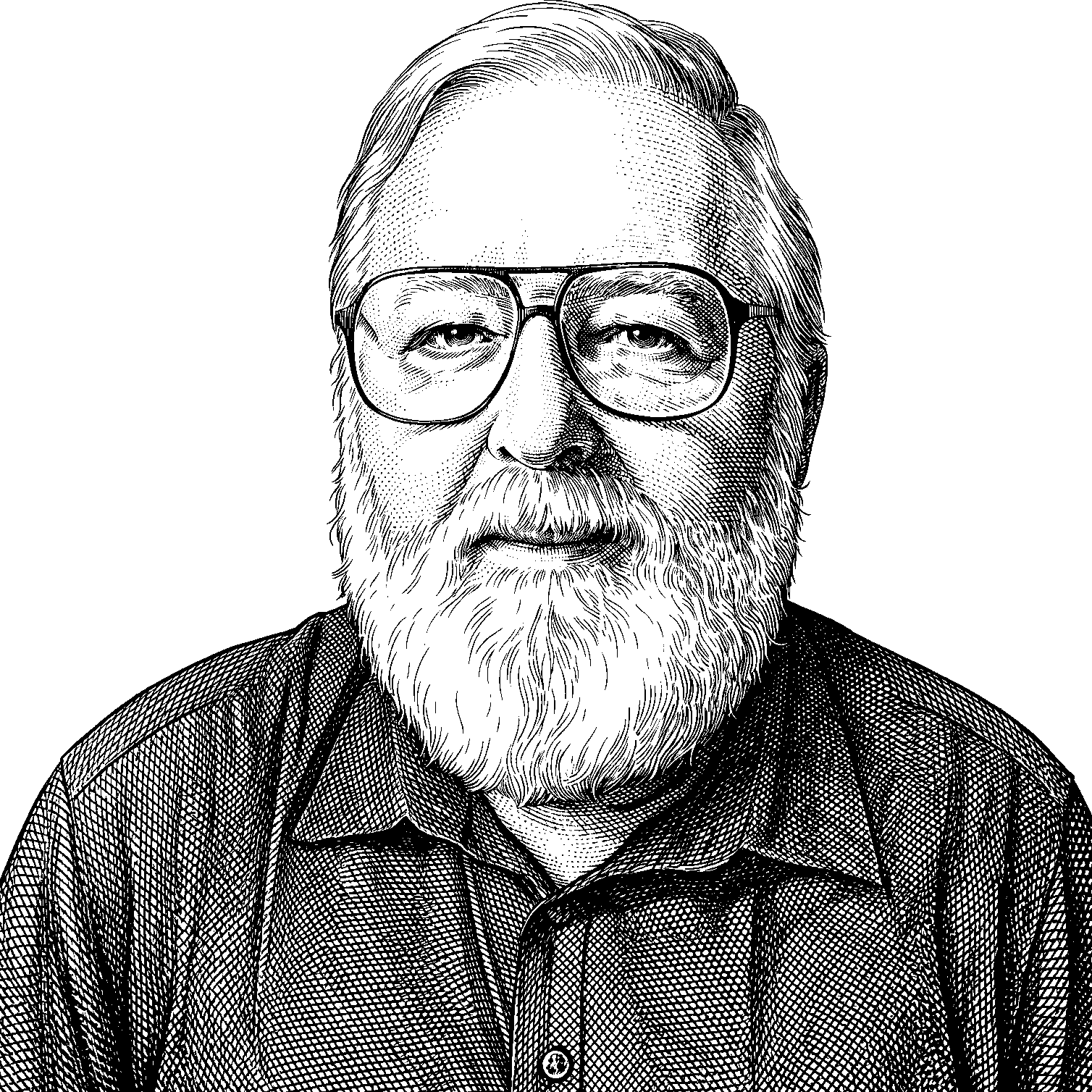
Malcolm Dean is a multi-disciplinary scholar and author whose research explores the fields of complexity science, cognitive neuroscience, and information theory. Currently a research affiliate within the UCLA Human Complex Systems Program and a member of the Higher Cognitive Affinity Group at the UCLA Brain Research Institute, Dean investigates the fundamental physical laws governing mental processes and social structures. His academic tenure at UCLA has been defined by both technical leadership and theoretical innovation, having served as a Principal Editor in the Department of Academic Computing and as a Principal Investigator for several scientific initiatives. ¶ At the core of Dean’s intellectual contribution is the development of "Cognitive Thermodynamics" and the Natural Philosophy of Information. He posits that human belief systems and cultural evolution are not merely social constructs but emergent properties of fundamental physics. In his 2020 work, Religion is Physics, Dean argues for a theoretical framework where social evolution is understood through the lens of entropy. He provides a thought-provoking link between the study of human meaning and the hard sciences by considering religion as a practical application of physical laws. ¶ Dean has been an influential figure in the discourse surrounding the intersection of spirituality and transhumanism. In his presentation at the Transhumanism & Spirituality 2010 Conference, titled "The End(s) of Mythology," he explored the transition from traditional mythological narratives to a "scientific mythology" grounded in the reality of an information-based universe. His work suggests that as our understanding of the brain and information theory advances, the ancient human impulse toward transcendence will find its ultimate explanation—and perhaps its fulfillment—within the laws of thermodynamics and computation. ¶ Through his research and writing, Dean continues to explore how the emergence of consciousness and the structure of human societies are dictated by the flow of information. His professional versatility extends into the public sphere as a journalist and computer consultant, allowing him to translate dense scholarship for a broader audience.
Transcript
Speaker 1
Malcolm Dean, his research in cognitive thermodynamics provides a consistent and scalable physics of cognitive, cultural and religious systems. And Dina’s a research affiliate of UCLA’s Human Complex Systems Program and a member of the Brain Research Institute’s Higher Cognitive Affinity Group. We’re very pleased to have him here. Thank you very much.
Malcolm Dean
How do I get here? Good morning. This talk will also represent something of a contemporary Buddhist critique to some of the theological discussions we’ve been having, and we can explore that later if you wish.
Malcolm Dean
No one doubts that our planet is in a critical transformation. What is in dispute Is whether anything can be done about it while preserving the current state of affairs. That is an insane proposition, but it forms the working hypothesis of most humans.
Malcolm Dean
To survive, we need to do only one thing: reverse the population boom that is gradually overwhelming the planetary ecology. Recent calculations suggest that the survivable population level is shockingly low, only 100 million. Against this dismal picture, many believe that innovation will save us just in time, or that increasing average lifespan will naturally reduce childbirth. Perhaps we’ll learn to love our inner cyborg and voyage to alternative universes. Perhaps we will morph ourselves at will, download knowledge and powers. and sing heroic songs under algorithmically generated night skies.
Malcolm Dean
But none of this is new Humans have always lived on the edge of disaster, predicted the end of time, demanded impossible sacrifices to repair the world. Exaggerated their adventures and proposed the procedures by which the natural order came to be so. We live in a time when old myths are dying fast and new myths rush to replace them. Just as they did some 28 centuries ago.
Malcolm Dean
At the boundary of the Axial Age, humans had retreated from nature into major urban centers. Personal experience of nature was gradually replaced with theory and technology, the ancient myths and shamanisms buried within our earliest texts and formal religious systems. What actually happened to human thought along the way? Why do cultures come with mythologies? Why do urban civilizations develop formal religious systems? exactly what is doing mythology.
Malcolm Dean
What is naturally obvious to a shaman is not naturally obvious to an urban academic taught from the first year of school that he is civilized. But to the ancient observer, hidden causes, vast results from tiny actions, and natural hierarchies are naturally obvious. Everywhere, the substance of being itself. Is in transformation.
Malcolm Dean
In Egypt, the cosmic principle of transformation was Kepur or Kepri Represented by the dung beetle, which rolls matter into spheres and pushes them along. Very Newtonian vision. We have been taught that there is little connection between insect behavior and celestial mechanics. But in Egypt, it was a naturally obvious example, providing intuitive access to physical law excuse me, to physical laws.
Malcolm Dean
Myths and rituals provide the terminologies, the performative algorithms, and social mechanisms to preserve and extend this knowledge. The term Upanishad itself is first used to mean equivalence, and the main function of the writings is to form equivalences. Ancient philosophy presents in intuitive language and symbols ideas that have only been discovered recently: complexity. Scale invariance, fractals, measurement theory, the observer, the horizon of information, nonlinear and topological thermodynamics.
Malcolm Dean
What happens at the boundary of the axial age is that a new experience of information distance occurs. distance from nature, distant trade networks, and knowledge of distant mythologies, cultures, and religions. The distance is not just geographic, because in cognitive systems, distance generates information. Now ancient Ionia, where the pre-Socratics mainly lived, sits at a trading distance from Egypt, close enough to do business, but far enough to retain intellectual dependence from the predominant religions. Of that time.
Malcolm Dean
In the Axial Age, Egypt was already over 2,000 years old, its temples and pyramids intimidatingly unsurpassed. To the ancient world it represented the ideal of Ma’at, natural knowledge applied to human and cosmic order. It was a teaching sufficiently senescent an ideal held at just enough distance that the Greeks would have to reverse engineer it.
Malcolm Dean
What we see in the profusion of Greek thought is a cognitive system actively engaging in Bayesian inference. Freed from a single dominant religious system, the Greeks could explore new ideas with the many degrees of freedom provided by their competing polytheisms and natural philosophies. It’s easy to dismiss their early discourse as incoherent. Aristotle himself had a very dim opinion of his predecessors, and this attitude was adopted by many 20th-century scholars.
Malcolm Dean
In Buddhism and Science, Donald Lopez recently denied any possible connection between the early Indian concepts of causality and the modern theory of relativity. It is preposterous, he argues, that an itinerant teacher of the Iron Age, India, understood the theory of relativity, quantum physics, or the Big Bang theory. But the ide the argument is not so easily won. Modern science is not the science that concerned the ancient world.
Malcolm Dean
It may seem quaint that water was called the first element, but today the laws of hydrodynamics are successfully applied even to the largest structures in the known universe as well as on scales of kilometers, centimeters, or even in the collective behavior of quantum systems, and even on Wall Street. You can make a similar argument about fire in the modern cosmological myth of the Big Bang. Today, Heraclitus could say it’s thermodynamics all the way up and all the way down. The Egyptians used to say, if you burn, you belong to life. Today, the study of energy transformation properties common to all systems is simply called network thermodynamics.
Malcolm Dean
Over the course of human culture, there is an obvious progression from natural observation to technical innovation to scientific abstraction. There is an obvious line between Horace and the horizon to the event horizon. Every horizon is the horizon of information. From the mythology and religions of prehistory to Hawking’s black holes and recent discoveries in neuroscience
Malcolm Dean
The core concerns of ancient mythological and religious systems are the creation and transformation of objects by deities in rituals or in the wild, the invariant as the true, survival by alignment with higher causality, and the quest for immortality through perfected identity.
Malcolm Dean
In contemporary science journals, we find similar terms such as miracles, which are downward causation, prayer, Which is upward causation, rituals, which are performative algorithms, and even angelic non-determinism. These are all words in recent journals. Such ideas could not be sustained under the linear paradigms of the Enlightenment, but they become naturally obvious in the new sciences of complexity, nonlinear thermodynamics, and information.
Malcolm Dean
But exactly what is doing this theorizing? The modern view suggests rational choice, counterintuition, inference The Western individual is isolated, self-oriented, and even antisocial.
Malcolm Dean
But with information networks, isolation is replaced by connectivity. Self-orientation is replaced by community. Antisociality is replaced by the addictions of texting and virtual worlds. The networked individual plays in a global village. Human nature is once again embodied, collective, and emergent.
Malcolm Dean
Cognition is an emergent hierarchy of collectivities. Brains are collective processes of neurons whose membranes define their own collective chemical and dendritic processes. And you can see in the left chart you have the brain organization of a child and the great amount of organization that occurs in the brain by the time he They achieve adulthood. These neural networks follow the same cabling laws as communication networks.
Malcolm Dean
The Internet was precisely designed for collective discourse. And here we see the global Internet represented rather like a sun with these flares going out. and they represent streams of information and connectivity around the globe.
Malcolm Dean
What emerges from these systems are maps of beliefs about the natural world, cognitive ontologies. The same information processes which create kinship systems, heavenly hierarchies, language, moral standards produce the objects of these ontologies. They bind and connect their respective domains into characteristic systems which define tribes, nations, religions, politics, and economies.
Malcolm Dean
Information is always physical. Because it is physical, it is thermodynamic. Thermodynamic systems naturally develop their own semantics. Cognitive thermodynamic systems naturally developed their own documentation, and we can see that humans around the world began to develop a very similar set of symbols in the early earliest pictograms.
Malcolm Dean
In a very simple system, we could say that physical force is all that is required for a self description. The hammer falls. But as intelligence increases, marking emerges as a social behavior. These are the Book of the Dead on a Tomb. And eventually cultures describe themselves in myths, hymns, and the arts. Texts emerge from collective systems because they’ve been checked out from semantic processes within collective cognition. These are emergent topics on today’s internet.
Malcolm Dean
So this begins to tell us what is doing mythology, but how. The problem of collective processes is not new. As far back as Ramon Lull in 1283, it has been addressed in the theory of multi-candidate elections. I. J. Goode used set theory to show how collective deliberations work toward a unitary decision in a process called the Condorcet election or the Condorcet choice. Neuronal populations go through this exact process when they’re discussing or debating an energy impulse and then producing some kind of reaction in a neural network.
Malcolm Dean
Walter Freeman showed that chaos in brain dynamics leads to a similar process in the olfactory system. So that the neurons are making condorcet choices as they proceed, and eventually the election reaches the one singular circle point. where the brain is able to develop or to determine what is the precise odor that it’s smelling.
Malcolm Dean
Set theory is notorious for the problem of the superset. Is the set of all sets a set itself? And what is outside that set? Can it be said to exist in the same way as sets within the superset? All religious systems must answer this same question. The superset diagram is the master logical formula for all theologies, because set theory inherently points to the transfinite. The iconography and mythology carried within each theology consists of vectors produced by religious systems to solve these problems.
Malcolm Dean
So we find Condorcet sets in ritual sites such as the Temple of the Sphinx, where a pair of sanctuaries point to the rising and the setting of the sun. The cosmological orientation they establish goes along one side of the Sphinx toward the pyramid complex, which is the site of the transformation of substance to eternal life.
Malcolm Dean
Another example is provided by the Sanctuary of the Sun at Lake Titicaca. In the first Condorce set, pilgrims elect to pass through the gate on the right side. They move toward the birthplace of the sun, which is the large mountain, the sacred rock, and they array themselves in a series of nested sets. according to the social status. And the higher social status get to stand exactly where you’ll see the solstice. The lower social status are nest sets outside of that, and they therefore get less of the impact of the vision and the experience. The entire process is aimed at a transcendent point that becomes visible as the rituals are fulfilled.
Malcolm Dean
A similar analysis of the Eucharist will show a condorce set in Catholic ritual. Rituals and ritual sites are cognitive algorithms. That produce pointers or vectors linking personal experience with the transfinite. The vectors point to physical objects as responses to these ontological challenges. a possible direction of solution.
Malcolm Dean
That there remains any uncertainty means that the final choice is always an act of faith, whether you’re talking about marketing decisions or you’re talking about uh any Bayesian process. As individuals contribute to or adapt to these condorcet choices, religious systems claim converts to their faiths, and then they point to the benefits of their selected vectors.
Malcolm Dean
The spaces between are very significant. From the earliest stone circles to the use of formal gates, doors, and screens, mythological and religious systems play with boundaries. As a way of pointing to their opposite, what my mathematician colleague Mark Bourbon calls anti-boundaries. In this unique Almec offering found at La Venta, a group of figurines gather before a set of stone verticals repeating this theme in miniature.
Malcolm Dean
But by the Middle Ages, repetitive ritual began to be replaced by deliberate exercise in cognitive recursion and logic. This stone from Nagarjunakonda begins with a point at the tail of the serpent. the point takes on three dimensions, then a circular trajectory, which forms a great circle of circles, and when this process is complete it points directly to the center of the circle and then comes to a higher dimension with Which is you, the observer. So when the higher dimension is invoked, the actual human observer looking at the stone Recognizes the process. And those familiar with Buddhist logic and ontological problem and the ontological problem of emptiness will recognize the statement.
Malcolm Dean
So far, the examples have illustrated binary choices. To provide a physical model, we need to turn to the term to the theme of three. The world’s first major religions in Egypt and India have always had Trinitarian elements. The precise meaning of the three and the relation between its elements have never achieved stability.
Malcolm Dean
In some configurations there are three separate gods Then we have Tripura Sundari, a single goddess or power with aspects that create, sustain, and dissolve existence. In the caduceus, we find two aspects of being orbiting around a central axis, finally pointing to a set of wings. Christian religious systems have oscillated between Trinitas Unitate, three and one, and Unitas Trinitate, I and III. And of course in Buddhism we find the major example and claim to threeness in the triple gem.
Malcolm Dean
Only by the Middle Ages do the full interpenetrating circles appear, full Boromean rings. The patterns also appear in a geometrical format alongside other knots such as Solomon’s knot. And these are all special topological formula which Also, play a role in Shinto symbolism.
Malcolm Dean
But it wasn’t until very recently, just a few years ago, that we actually began to find these things as not as mythological or geometrical assertions, but as actual physical systems. And there was a great deal of excitement. when these were not only discovered, but they were actually created successfully in the laboratory at the nano scale. Now it’s thought that Boromean rings actually play a role in the cosmological structure. They have an effect upon the way clouds and galaxies will form and process as they go along.
Malcolm Dean
But the identification of three rings does not itself qualify a system as Borromean. What happens in a Borromean system is that two rings cannot bond but three together form a collective physical system that disappears when one link is destroyed. So it’s not as simple as pointing to three c uh circles that interpenetrate And this provides us with a physical model for the relationship between cultures, religions, and cognitive units.
Malcolm Dean
Cultures and religions are usually studies as objects in themselves, objects that hierarchically organize objects within themselves and between other cultures, religions, and individuals. This provides objects of academic study, but it requires that an unrelated field, such as economics, evolutionary psychology or neuroscience, is implied or injected into these objects in order to make sense of them.
Malcolm Dean
So, looking at the systems that produce these cultures physically, as physics, religions, and individuals, this means that we can remove some of the mystery and get right down to physical theory. Even Wall Street is employing physicists to make fortunes these days. Physical theory is being applied across the humanities and life sciences. Because it is already it comes ready with sophisticated tools for dealing with complexity, emergence, and causality. As we’ve seen now, religion is actually physics expressed in the language of being. Religious systems are physical systems. Religious organizations are cognitive networks.
Malcolm Dean
Cultures build religions for specific purposes, as cosmic maps, as memory banks of experience, as prior inferences. And religions build cultures for their specific purposes. What we see in monuments and mythologies are snapshots of cognition in these large-scale systems. The third ring is provided by cognitive units.
Malcolm Dean
Cognition is not the domain of the isolated rational mind. It is a collective process, always comparing results with other cognitive units, which may be neurons inside a brain, couples. family groups, social organizations, political parties, nations and empires. Information processes occur among these networks and are not necessarily related to the biological individual.
Malcolm Dean
Thus, what we have, what we are, are participants in Borromean systems consisting of cognitive, cultural, and religious rings. All three systems require and co-create each other to maintain bonds in a continuous dynamic with their physical environment. Sorry. The active activity of each ring is distinct.
Malcolm Dean
Culture deals with closed processes. the finite, the countable. It creates boundaries, defines membership, calculates kinship systems, produces accounting methods, language and law. It creates rigid paths to define destinations.
Malcolm Dean
Religion deals with open systems which constantly threaten to approach the transfinite. Its domain is the unbounded, the uncountable, the unknowable, the distant, the foreign, the mysterious.
Malcolm Dean
In a healthy system, the cognitive contributes to its culture, practices its faith, believes its mythology. In return, cultural and religious systems provide physical structure. In a pathological system, one of these circles believes it is the fixed defining point, or it mistakes itself as one of the other rings.
Malcolm Dean
A fixed individual considers himself dictator and demands that culture and religion serve his purposes. A fixed culture demands that individuals behave in certain ways and practice specific Specific religions. And a fixed religion demands that cultures and individuals ignore their specific needs. Worse, a religion that considers itself to be a culture. Or a culture that considers itself to be a religion produces an untenable configuration that always ends in violence and destruction.
Malcolm Dean
The shock of this planetary crisis is that we never stepped outside of this physical system. We never were enlightened in the European sense. We never rationally separated from the physical forces at play. We were never other than this cosmos itself unfolding. What faces us now
Malcolm Dean
Well, we are on a critical path, not because our choices are critical or our situation is critical, but because physical processes always maintain critical paths. What we face as a species and as a planet is not an exception, not a deviation, not a sin, not a mistake. It is the natural path of events. And if we think there is a non-lawful way beyond this crisis, then we have not paid any attention to our modern mythologies. Thank you.
Speaker 1
As Spencer is coming up, we probably have time to I would like to ask Dr. Dean a question.
Speaker 3
I’m sorry. Do you know who Michael Leed is? No. He’s coming recently to write a story about this. Can they hear you? I can’t hear you. We have a mic. Yes, just turn it on. That’s fine. Yeah. I’m just saying Michael Lee was talking about speech without Science and religion are about talking about the end of the world coming up and how that affects the human psyche. I think you’re using
Malcolm Dean
I said all systems go on critical paths. It’s not an exception. That’s Western dualism. You’re still trying to maintain this separation from reality, basically, that has been so popular in the West over the past few Centuries and still permeates all our science. So, you know, if you want to say, you know, nifty spiritual things like, oh, it’s all one being and we’re all part of God. or something like that. You know, many religions have different terminologies they apply to that assertion. You can’t maintain that. sort of cosmic attitude and say what you just said. Because what you’re saying is that, you know, th this is happening outside of that system.
Malcolm Dean
And what I’m saying is it’s all physics. Physics is the language, the neutral language that wraps all this together. When I hear about angelic hierarchies, I think about hierarchical causality. You see, when you talk about agencies and powers, I hear dynamics, physical dynamics. So these ancient systems are attempting to describe these systems in a language. Which is accessible because they did not have modern complexity science, they did not have supercomputers, but they did have effective plain language that even a shepherd Can understand that gets these points across. The point is that in the last three or four centuries of Western science, we just dumped all that, called it mysticism and nonsense. And it’s not. And we know that now.
Malcolm Dean
The Wall Street crash should have explained that to you, that there is no outside to the system. The boundary of a boundary is zero. That’s Buddhist logic. And that’s what escaped the Wall Street clown. That there is no outside. You know, you can’t progressively minimize risk into it. Infinitesimal value. The system will collapse, the Boromian rings will separate, and you get chaos until a new system forms. So that is the illusion. That is the modern mythology. That is the intellectual error of the Enlightenment. Excellent. Thank you very much. Thank you.