Playing God: The Implications of Christian Theology for AGI
Micah Redding examines what Christian theology can contribute to debates about artificial general intelligence and the alignment problem. Drawing on Catholic and Orthodox thought, he argues that classical Christianity rejects the "orthogonality thesis"—the idea that intelligence can pursue any goal—instead holding that true intelligence naturally aligns with goodness. Using Richard Dawkins's selfish gene theory and David Deutsch's work on memes, Redding proposes that aligning AI requires embedding it in relationships of reason, communication, and trust rather than hard-coding specific values. He concludes that the ancient question "How many angels can dance on the head of a pin?" was really asking about the relationship between intelligence and matter—a question now central to the multi-billion-dollar AI industry.
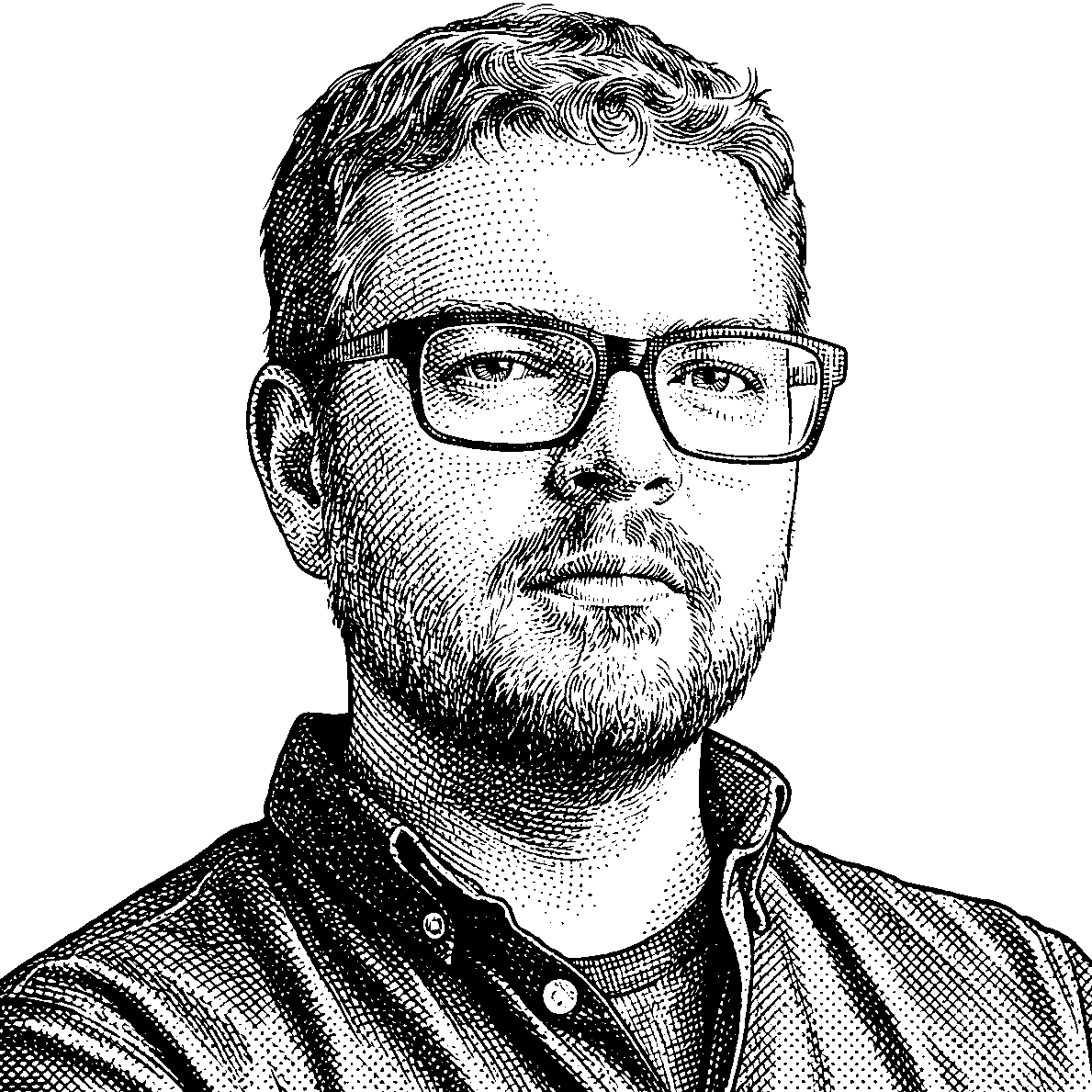
Micah Redding is a multifaceted individual with a diverse background. He experienced his formative years as a preacher’s kid before transitioning into a career as a rock musician for eight years. He has also had a mysterious experience involving a high-speed pursuit of a spy plane. ¶ Currently, Micah focuses on software development and writing, exploring the intersection of human values and technology. He is particularly interested in exploring Christian views of resurrection and how they apply to transhumanism. ¶ Micah is a key figure in the Christian Transhumanist movement. He is a founder, board member, and the Executive Director of the Christian Transhumanist Association.
Transcript
Micah Redding
I am glad to be here. It’s great to talk with a lot of you, and I look forward to talking with many more of you. To be back, and just thank you for having me.
Micah Redding
So, like I said, I want to start with something ridiculous. If you’ve heard the question How many angels can dance on the head of a pin? You’ve probably heard it in the context of making fun of ancient or medieval theology for engaging in these abstract. Obscure and ultimately meaningless sorts of questions, right?
Micah Redding
But what I want to suggest is that actually many of the questions that ancient theologians were engaging with are consistent with a lot of the questions we’re asking and engaging with today. And if you dig into this just a little bit, it becomes fairly obvious.
Micah Redding
Because if you think about what is this question, angels on the head of a pin, you realize very quickly it’s a question about the relationship between intelligence and matter. And in case you haven’t noticed, the question of how much intelligence we can fit onto a given unit of matter is not only like an active engineering and philosophical question, it’s the basis of multi, multi-billion dollar industries.
Micah Redding
So, I think sometimes it can be helpful for us to go back when we’re engaging with these big open-ended questions about the future to go back and look at some of the questions that our ancestors Engaged with and some of the answers and options that they may have entertained that we may have forgotten about.
Micah Redding
So, the two concepts I want to look at related to this are the orthogonality thesis. Which is that intelligence may be aimed at any particular goal. It could be aimed at creating vast good, vast evil, or vast absurdity, such as turning the entire universe into paperclips or office supplies.
Micah Redding
And what comes out of that is the alignment problem, which is that if intelligence indeed can be suited with any of these particular goals Then, how do we get intelligence that has the kind of goals that we think are good and valuable and beautiful? So, these two problems are active and ongoing areas of discussion.
Micah Redding
Could ancient theology weigh in on these topics? So, I want to suggest that maybe, in fact, different religious traditions have different answers to this question.
Micah Redding
So, I’m not an expert in Hinduism. I am just a superficial observer of Wikipedia. But it’s interesting to me that when you look at Questions about who are the gods in different religions that you get different kinds of answers.
Micah Redding
So the Hindu Tramurti consists of Brahma, Vishnu, and Shiva. Is known as the Creator, the Preserver, and the Destroyer.
Micah Redding
Now, just superficially, This looks to me like it suggests that Hinduism embraces the orthogonality thesis. That it seems to say that intelligences that can create one thing might be met with intelligences that want to destroy. Those things and vice versa, right?
Micah Redding
And again, I don’t know if this really has merit beyond this superficial analysis, but if it did, something that would be really cool. Is that scientists who were inventing technologies that could be used for great good or great evil, great creation or great destruction? They could mine Hindu scripture for Quotes that would really help them evoke this idea in the public consciousness. Just an idea, somebody could run with that. All right, so
Micah Redding
If it’s possible for a religious tradition to endorse the orthogonality thesis, is it possible for a religious tradition to reject it? I think the answer is, in fact, yes. And I think when we look at the Catholic and Orthodox traditions, they perhaps actually have a strong tradition of rejecting the orthogonality thesis.
Micah Redding
So, if we look at the Christian Godhead as they define it, we have Father, Son, and Spirit. And if you ask, this is not A set of entities known as creator, preserver, and destroyer. But if you ask a theologian, they will say something like, Well, this is creator, creator, creator. They might represent different forms or modalities of God, but they are all aimed at the same thing.
Micah Redding
And this is dogmatically the case, so much so that It’s insisted that every action is a shared and collaborative action. That’s the level of their alignment.
Micah Redding
And what this suggests is that intelligence itself has a different characteristic. It’s not just something that you can align towards anything. Intelligence itself is alignment.
Micah Redding
And so, theologian David Bentley Hart kind of expresses this idea: the bad The better the rational will knows the good for what it is, the more it is freed from those forces that distort reason and lead the soul towards improper ends, the more it will long for and seek after the true good in itself. And conversely, the more rationally it seeks the good, the freer it is. All of an intelligent being’s desires and wills occur in the context of a consuming rational desire for the good, the true, the beautiful. Otherwise nothing would prompt the rational will into action. But this consuming rational desire is, in fact, simply a way of naming the essence Of God. Every other Christian tradition affirms this.
Micah Redding
In other words, he is saying intelligence itself is alignment. Intelligence is alignment with God.
Micah Redding
And I think this is what we see in Dante’s Divine Comedy. As he ascends towards God, which incidentally is where we derive the term transhumanism, his description of this ascent, as he ascends towards God, he finds it to be a converging ascent. An ascent in which all beings are converging on a single point.
Micah Redding
And as he passes through onto the complete perception and awareness of God, he sees God presented to him as three. Circles perfectly aligned. And he says at the summary of his poem, he says, as he contemplates The nature of God. He says, But already my desire and my will were being turned like a wheel all at one speed by the love which moves the sun and other stars. In other words, as he comes to know God, he desires the the perfect good that God himself embodies. Intelligence, in Dante’s view, is alignment with the divine nature, the divine purpose.
Micah Redding
Now, this idea that intelligence itself is alignment, the rejection of the orthogonality thesis, raises some big problems. And the first one is: how do you account for evil in a world like this? And this is more of a problem for Christianity because Christianity has publicized and promoted and made famous the veritable charismatic megafauna of unaligned spiritual entities. Right, and this guy should not have been possible in this world, right?
Micah Redding
If, especially in some accounts, as Satan is the second in command next to God and yet turns his back on God and falls. Even just considering the consequences of that should not have been possible for a super intelligent being, right? So, how do we make sense of these two things?
Micah Redding
I hope you’re not surprised to know that this is a well-understood problem and has been thought about for thousands of years. So I think there actually is a set of answers to this or set of options and possibilities that are explored. And there is one answer that I see again and again that I would think of as a kind of consensus answer in this scheme of things, although it is not well known beyond the kind of circles of people that think of this. And that answer is simply this.
Micah Redding
Satan is not a superintelligence at all. Satan is something much more like an animal, a beast, a monster, a contagion, a virus, a parasite.
Micah Redding
And so New Testament and Bible scholar N. T. Wright consistently refers to Satan as a sub-personal force. Reflecting this kind of idea and the biblical imagery around Satan as a dragon or a snake or a serpent.
Micah Redding
And then when you get to Dante’s depiction of Satan as he descends to the pit of hell. What he finds is not the Lord of the demons, but actually a monster gnawing on human carcasses, imprisoned in ice. Beating his wings to cool the air to freeze the very ice that holds him entrapped. This is not a super intelligent schemer. This is a psychotic being caught in a mindless, self-destructive, infinite loop. That is Dante’s picture of God, or I’m sorry, of Satan.
Micah Redding
And. And I think it is, as I say, a consistent one that you find it again and again.
Micah Redding
So René Girard, himself a Catholic, will summarize this. He says, Satan has no real being. He exists always as a parasite on the being of humankind. Just as theology tells us that he exists as a parasite on the being of God. Satan is imagined and symbolized as a person, as someone, because satanic power becomes attached to the victim. Understanding Satan as a contagion enables us to acknowledge the importance of the prince of this world. without also endowing him with personal being. Traditional theology has rightly refused to do the latter.
Micah Redding
So what he’s saying is the reason we picture and understand Satan in these personal terms and having these personal properties is not because Satan has properly personal properties of his own. It’s precisely because he is a parasite on persons and takes their personal attributes and characteristics and twists them and turn them to his own ends.
Micah Redding
So how do we make sense of this set of ideas, this idea of divine intelligence alignment and a parasitic Satan? How do we translate this into contemporary terms to kind of inform options and possibilities in contemporary discussions?
Micah Redding
As usual, with every question about religion, I think the answer goes back to Richard Dawkins. So who despite his best efforts has I think given us the source book of theology, Christian theology for the 21st century. And I’m speaking of course of the Selfish Gene, the 1976 classic.
Micah Redding
And what he lays out in this book is a proposal, an understanding of evolution in which evolution does not occur primarily at the level of the organism, but at the level of the replicator. The gene itself. And this allows him to analyze problems in a new way.
Micah Redding
And so, one of the things he tackles in this book is the distinction between organisms and parasites, between genes that make up an organism and genes that make up a parasite. And his idea about the distinction, I think, is one of the most profound ideas I’ve ever encountered. He says the difference is in their path to the future.
Micah Redding
In other words, every gene has a replication strategy. And some genes have a replication strategy that involves them collaborating and participating in the reproductive process of the organism. And when they have that replication strategy, then over generations and generations and generations, they will necessarily find themselves in alliance with all the other genes that share that replication strategy. In fact, the organism itself is best understood as the embodiment of that shared replication, that shared alignment.
Micah Redding
Conversely, a parasite is something that has a different path to the future that passes from host to host to host without going through the reproductive Process without entering into alignment with all those other genes. And consequently, over generations of replication, it will find itself in alliance with all these kinds of genes that have an orthogonal, a divergent, and ultimately an antagonistic replication strategy.
Micah Redding
So the other idea that Dawkins introduces in this book. It’s called the meme. And he introduces this term for ideas that themselves replicate from mind to mind. And he introduces it to make the point that the principles that govern biological replication also govern other forms of replication. And although he doesn’t flesh this out in extensive detail, Other people have.
Micah Redding
And particularly, I’m thinking of physicist David Deutsch, who is a quantum computing pioneer. And in his book, The Beginning of Infinity. has tackled the question that Dawkins raises. And essentially, Deutsch says, any kind of replicating idea has only two possible paths to the future. Only two possible replication strategies.
Micah Redding
It can either appeal to our rational faculties, it can try to be something that is useful Or meaningful, or true, or beautiful, or good, something that we would want to pass on towards other friends and our families and so forth. Or it can do everything it can to thwart that rational decision-making process.
Micah Redding
So Deutsch says, given these two replication strategies and how antagonistic they are to each other. It is necessarily the case that over time, over generations of replication, ideas that support this pro-rational strategy will necessarily align with other ideas. That uphold and sustain and support rational intelligence wherever they find it. And conversely, The anti-rational ideas, the anti-rational memes, will necessarily form alliances with all the other memes that work to distort and destroy and to warp rational intelligence wherever they find it.
Micah Redding
And this has significant ramifications for how we think about what intelligence is. Because it means that our minds themselves are necessarily the site of this spiritual struggle between the memes of reason and the memes of unreason, the memes of light and the memes of darkness. And it means that alignment is not something about intelligences or organisms. It’s ultimately something that happens at the level of the memes themselves and the replication strategies that we choose to cultivate or sustain or uplift.
Micah Redding
And so if we want to build an AI that pursues the sorts of things that we believe to be good and true and beautiful and all the other things. The focus should not be on trying to hard code in certain drives or desires, which will just be mutated away over a few generations. The focus should be on embedding intelligences in pathways of mimetic communication that we find to be cultivating of these true and good and beautiful things. In other words, we need to engage these AI in relationships of reason and communication and love and trust.
Micah Redding
As Paul says, our battle is not against flesh and blood, and as he might have continued, but against spiritual forces and mimetic processes of replication. This is what we ultimately face with regard to AI, with regard to people around us, with regard to all the intelligences we engage with. What kinds of memes and memetic replication strategies are we going to support and sustain? Are we going to support the ones that themselves uplift intelligence or themselves tear it down?
Micah Redding
And I think if I had to choose between these two different forces, I would want to choose the memes that support the idea that intelligence itself is good. Intelligence itself should be uplifted and upheld. Intelligence itself should be supported because intelligence itself is part of this ultimate pathway towards God.
Micah Redding
And I think if we have to answer the question, how many angels can dance on the head of a pin? I think the answer is all the ones that can stand and dance in the light. Thank you.