Micah Redding

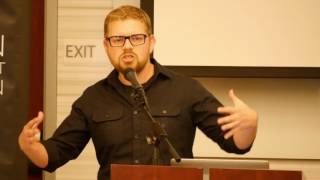
Portrait of Micah Redding

Micah Redding is a multifaceted individual with a diverse background. He experienced his formative years as a preacher’s kid before transitioning into a career as a rock musician for eight years. He has also had a mysterious experience involving a high-speed pursuit of a spy plane.

Currently, Micah focuses on software development and writing, exploring the intersection of human values and technology. He is particularly interested in exploring Christian views of resurrection and how they apply to transhumanism.

Micah is a key figure in the Christian Transhumanist movement. He is a founder, board member, and the Executive Director of the Christian Transhumanist Association.
Videos by Micah Redding

Playing God: The Implications of Christian Theology for AGI
17:58

Micah Redding

Playing God: The Implications of Christian Theology for AGI

Micah Redding examines what Christian theology can contribute to debates about artificial general intelligence and the alignment problem. Drawing on Catholic and Orthodox thought, he argues that classical Christianity rejects the "orthogonality thesis"—the idea that intelligence can pursue any goal—instead holding that true intelligence naturally aligns with goodness. Using Richard Dawkins's selfish gene theory and David Deutsch's work on memes, Redding proposes that aligning AI requires embedding it in relationships of reason, communication, and trust rather than hard-coding specific values. He concludes that the ancient question "How many angels can dance on the head of a pin?" was really asking about the relationship between intelligence and matter—a question now central to the multi-billion-dollar AI industry.

Spirituality and Superorganisms
18:07

Micah Redding

Spirituality and Superorganisms

Micah Redding argues that religions, corporations, and ideological movements constitute "superorganisms"—collective entities that possess their own drives, survival instincts, and evolutionary dynamics. Drawing on Richard Dawkins's concept of memes and memeplexes, he proposes that ancient religious language about spirits, demons, and "principalities and powers" represents early humanity's attempt to grapple with these nonmaterial forces that live in and through us. Redding suggests that cultivating benevolent superorganisms—like Paul's "body of Christ"—may be the most effective strategy for combating malevolent ones.

Christianity as Transcendent Humanism: Humanity's Infinite Reach
14:46

Micah Redding

Christianity as Transcendent Humanism: Humanity's Infinite Reach

Micah Redding unpacks the early Christian doctrine of Christ’s bodily ascension as expressing a “transcendent humanism”—the belief that humanity, not angels, holds the supreme role in cosmic destiny. Drawing on Psalm 8 and the book of Hebrews, he shows how the first Christians insisted Christ retained his human body in heaven precisely because discarding it would mean humanity could not fulfill God’s purposes. This vision holds together three rare commitments: unlimited human potential, transformative progress through history, and radical equality of all persons. Physicist David Deutsch’s work on the human mind as a “universal Turing machine” with infinite reach offers striking scientific resonance with this ancient theological claim about human nature.

The Infinite Resurrection
13:32

Micah Redding

The Infinite Resurrection

Micah Redding, Executive Director of the Christian Transhumanist Association, argues that Christianity is fundamentally the religion of resurrection—not merely the immortality of the soul, which was common across the ancient world, but the resurrection of the body. He outlines three profound implications of this doctrine: it affirms the goodness of physical reality against Gnostic beliefs that matter is evil; it establishes the intrinsic value of life and our daily activities rather than treating existence as merely “biding time for death”; and it unites humanity in a shared future where the consequences of our actions matter. For early Christians, resurrection was not a single event but an ongoing organic process beginning with Jesus and extending through his followers to the transformation of the entire cosmos.

The Urgent Need for Christian Transhumanism
10:38

Micah Redding

The Urgent Need for Christian Transhumanism

The speaker contrasts "horizontal progress"—spreading current technologies and lifestyles globally—with "vertical progress," the creation of genuinely new solutions through human creativity and innovation. Drawing on Peter Thiel’s work, he argues that horizontal progress alone is unsustainable and that humanity needs orders of magnitude more people engaged in the kind of long-term, creative thinking that transhumanism represents. However, he observes that transhumanism faces a perception problem: some view it as wanting to eradicate humanity. Meanwhile, Christianity faces its own challenge of potentially becoming reactionary rather than engaging with scientific and technological change. Christian transhumanism, he proposes, can bridge these worlds—helping two billion Christians engage with the serious challenges of the next century while grounding transhumanism in an appreciation for the full breadth and depth of human life.

Analysis, Loss of Meaning, and Religious Transhumanism
12:09

Micah Redding

Analysis, Loss of Meaning, and Religious Transhumanism

Micah Redding explores how analytical thinking, while essential for progress, can dismantle the systems of meaning that give our lives coherence—much like dissecting a frog leaves something missing even when all the pieces remain. He argues that religious transhumanists often excel at analysis but struggle with the complementary task of building new meaning, leading to a sense of loss even among those who successfully reconstruct their worldviews. Redding proposes that the solution lies not in abandoning rationality but in becoming better storytellers, recognizing that religious transhumanism offers a uniquely powerful narrative—one that unites ancient questions with modern ambitions into a single story about what it means to be human.

A Better Apocalypse: Ancient Eschatology for a Transhuman World
15:26

Micah Redding

A Better Apocalypse: Ancient Eschatology for a Transhuman World

Micah Redding contrasts the failed end-of-world predictions exemplified by Harold Camping with the ancient Jewish prophetic tradition that viewed apocalypse not as history’s arbitrary termination but as moments when oppressive powers are overwhelmed by the rising tide of justice. He argues that this "better apocalypse" drew people more deeply into the world rather than out of it, inspiring figures like Martin Luther King Jr. to stand for truth even when victory seemed impossible. Redding suggests that spiritually oriented transhumanists can offer a similar forward-looking vision—one that calls humanity to courage and engagement rather than despair.

Transhumanism and the Christian Story
10:21

Micah Redding

Transhumanism and the Christian Story

Micah Redding traces a historical arc from Christianity through humanism to transhumanism, framing each movement as an expedition sent by its parent culture to explore ideas it could not fully develop on its own. He argues that the proper connection between Christianity and transhumanism lies not in superficial parallels but in a shared understanding of humanity as fluid, dynamic, and always changing. Beginning with Judaism's revolutionary claim that humans are made in God's image, Redding shows how the Apostle Paul's declaration that there is "neither male nor female, slave nor free, Jew nor Greek" anticipated the transhumanist impulse to transcend inherited boundaries of identity.