Spirituality and Superorganisms
Micah Redding argues that religions, corporations, and ideological movements constitute "superorganisms"—collective entities that possess their own drives, survival instincts, and evolutionary dynamics. Drawing on Richard Dawkins's concept of memes and memeplexes, he proposes that ancient religious language about spirits, demons, and "principalities and powers" represents early humanity's attempt to grapple with these nonmaterial forces that live in and through us. Redding suggests that cultivating benevolent superorganisms—like Paul's "body of Christ"—may be the most effective strategy for combating malevolent ones.
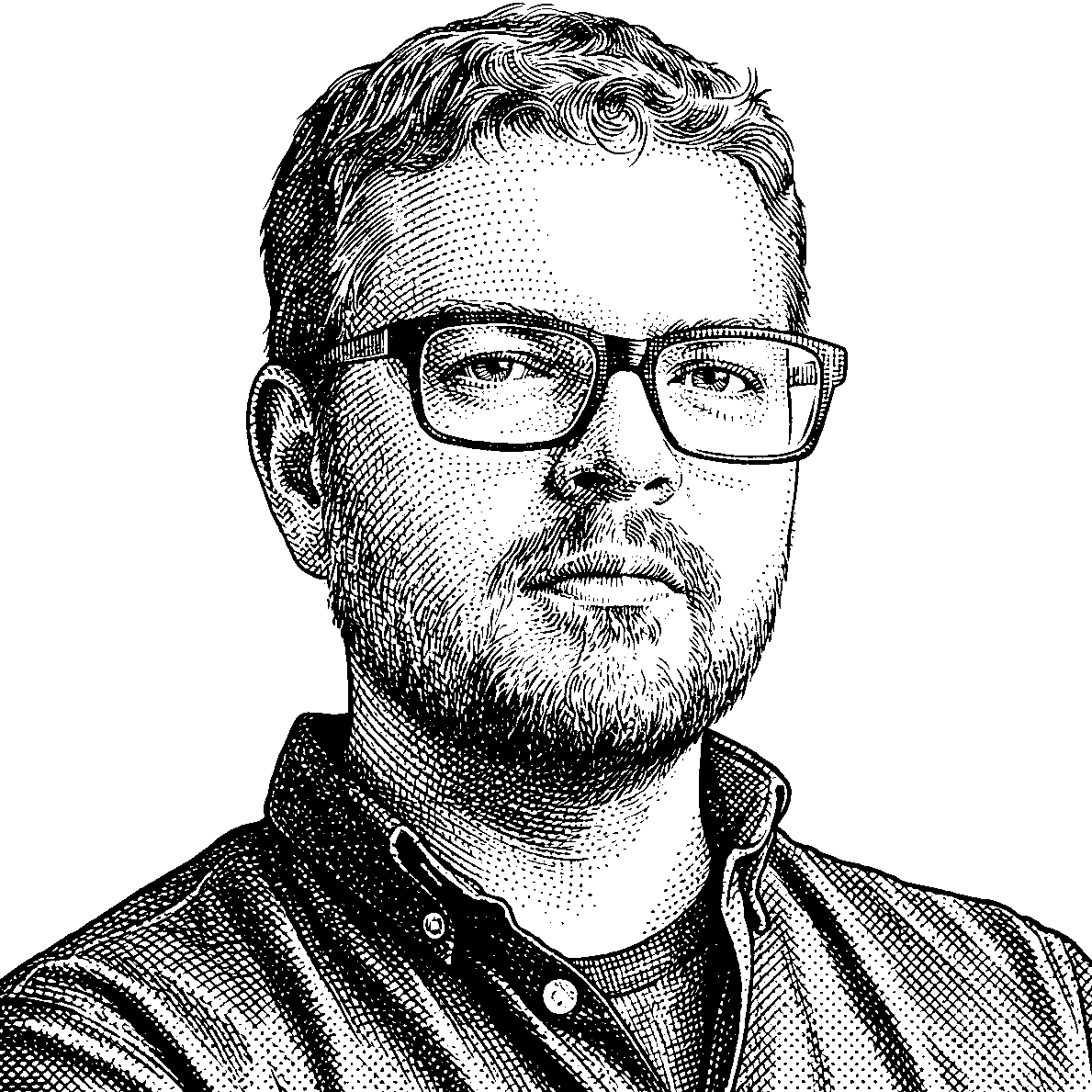
Micah Redding is a multifaceted individual with a diverse background. He experienced his formative years as a preacher’s kid before transitioning into a career as a rock musician for eight years. He has also had a mysterious experience involving a high-speed pursuit of a spy plane. ¶ Currently, Micah focuses on software development and writing, exploring the intersection of human values and technology. He is particularly interested in exploring Christian views of resurrection and how they apply to transhumanism. ¶ Micah is a key figure in the Christian Transhumanist movement. He is a founder, board member, and the Executive Director of the Christian Transhumanist Association.
Transcript
Speaker 1
Next up, Micah Redding is a software developer and the executive director of the Christian Transhumanist Association. He is an international TEDx speaker and educator, and a contributor to Vice Motherboard, The Huffington Post, IEET, and Humanity Plus magazine. His travels have taken him to Tahrir Square during the Arab Spring and Afghanistan during the war. Mike is a member of Mensa, a teaching fellow at Exosphere Academy in South America, and the host of the Christian Transhumanist Podcast. Where he interviews leading edge thinkers in religion and technology. Please welcome Micah Redding.
Micah Redding
Thank you guys so much. So let’s see. Let’s see if I know how to control this. Yeah, okay.
Micah Redding
So, one of the most distinctive features of traditional religious. Worldviews is this belief in creatures outside the bounds of normal organic life. So while we might talk about animals, plants, bacteria, fungi, and things like that. Religions often regale us with menageries of gods and goddesses, spirits, angels, demons, ghosts, souls, and so forth. And this leads many people to conclude that religion is a form of superstition.
Micah Redding
So it maybe will surprise you to know that the first person to show me that this perspective was true. Was Richard Dawkins. So Richard Dawkins, in his groundbreaking 1976 book, The Selfish Gene, actually coined the term meme. And many of us today would think of this term as meaning an image with a kind of humorous caption that we spread on the internet. But the original concept was actually far broader. Dawkins meant it to include any kind of idea, concept, verse. Verbiage, tune that could spread from a human to another human.
Micah Redding
And his point was that the same evolutionary forces that drive selfish genes are at work in the ideas that come to dominate. It’s not necessarily the case that the ideas that dominate our minds and our societies are the most true or even the most desirable. It’s the case that they’re the ones that do the best job convincing us to spread them.
Micah Redding
Right, so you can think about this in all kinds of terms One way maybe would be in the classic example of a chain letter. If you ever got one of these back in the day, you might have seen a list of promises and threats. At the top, right? And so it would say: if you send this on, here’s all the great things that will happen to you. And if you don’t send this on, here’s all the terrible things that will happen to you. And of course, the chain letters that were most successful were the ones that did the best job manipulating your emotions. And we saw those jump from postal mail all the way to email forwards and then to Facebook posts. And maybe you’ll see something like that today that says, if you don’t share this, it might be because you don’t love Jesus, right? And so this is a pervasive, pervasive phenomenon.
Micah Redding
And the term meme itself is maybe one of the most profound examples of this because it itself leapt. The fence from this kind of academic world of literature into the much more ecologically lucrative world of social media. As a great man once said, life always finds a way.
Micah Redding
So this is, Dawkins hadn’t just coined a nifty term, he’d actually thrown open the door. to an entirely new ecosystem. And one of the first things that people realized in thinking about how memes work is they realized that memes cooperate. And so we could call these memeplexes. Ideas spread better when they work with other ideas. And so you might think about the idea of science or rationality, and you might be drawn to spread those to other people. But the thing is that you’ll be much more drawn to spread science or rationality to other people if you’re also threatened by the idea of superstition. And so, the idea of science and the idea of superstition go hand in hand and help cooperate to spread each other. And this is what a memeplex is: a set of cooperative memes.
Micah Redding
And if you want to see how complex. and how big that can grow well you have to look no further than religion because religions are memeplexes To the ultimate degree. And they are full of art and philosophy and concepts and literature and scripture and hymns and cathedrals. And they all work to draw you into them. And if you’re drawn to religious music, you’re drawn into religious themes. And if you hear religious themes, you might be drawn to religious philosophy, religious literature. And even if you’re incredibly secular, you might wander into a cathedral. and suddenly find the architecture itself invoking these long-dormant memes to spring back into vibrant life.
Micah Redding
A lot of religious people might be bothered by that analysis, so it’s important to say that this is not about what’s true or false. It’s about how things spread. And one of the ways things spread is not just mentally, but also physically. So religious memeplexes create cathedrals and temples. Artistic memeplexes create sculptures and paintings, and scientific and technological memeplexes create tools, technologies, super colliders, and the Internet. And Kevin Kelly calls this the technium, the entire ecosystem of products of human civilization and human culture. And he argues that we should actually think of this as a seventh kingdom of life, whose genes are our ideas. and whose bodies are our tools. And just as our genes produce bodies which help spread genes, our ideas produce tools which help spread ideas.
Micah Redding
And this is a huge system, and it’s not just something we can locate in specific artifacts. This kind of evolutionary process is complete and it goes all the way to things that live in us and among us. And through us.
Micah Redding
And one of the most profound examples of this we can look at in the modern world is corporations. If you think about what a corporation is, It is born, it grows, it dies, it consumes, it excretes, it has its own drives and desires. And if you’ve ever worked for a corporation, you might know that you’re legally forbidden from pursuing your own ends. You have to actually pursue the ends that it has. They’ve even convinced us to legally classify them as persons. And Charlie Strauss has recently called corporations the first AI. And I don’t think he’s wrong, right? And so next time you’re actually talking to a customer service agent or dealing with a bureaucracy, Realize you’re not talking to a human being, you’re speaking to a non-human intelligence, which is using human faces to communicate.
Micah Redding
Corporations are just one example. Every organization and institution is some kind of version of this. And it’s not just things that we recognize legally in our society. It’s also things that are far more ephemeral or dangerous. We might think of a riot that breaks out and takes over a crowd of people and then quickly dissipates. Leaving people feeling like maybe they’ve been possessed by something. We might think that if this kind of thing happens accidentally, well, it could happen intentionally. And this is the concept of the egregor, which is when a group of people come together to incarnate a god or a demon. It’s the kind of thing people are playing at with seances and party games and Ouija boards. And you might think, well, maybe if they d dedicated more time and effort to it, they might achieve more substantial results. And so all of these kinds of things, I think, form a vast ecosystem that we’ve only just begun to glimpse. I call them superorganisms.
Micah Redding
The theologian Walter Wink called them the powers, after St. Paul’s language in the New Testament, that our struggle is not with flesh and blood, but with the principalities and powers in the heavenly places. And Wink’s point, just like Paul’s point, is that the tactics and techniques we use to struggle with other humans don’t work the same way against superorganisms. Just like trying to contain a meme often helps it to spread, trying to fight superorganisms often backfires. And so we need new tools and new techniques and new strategies. And one of those strategies might be cultivating benevolent superorganisms, which can then fight malevolent superorganisms on their own turf. And at least one religion has the explicit aim of creating just such an organism. Christians call it the body of Christ.
Micah Redding
So this is not the new realization. This is probably one of the first realizations that humanity ever had as they dawned into emerging self-awareness. Just like at the beginning of the internet, it had to suddenly seem as if viruses were everywhere. And the idea that someone could be possessed Taken over, transformed, that individuals and families and tribes were being driven by some kind of non-material dimension of life. Had to be not just an abstract theory, but the most concrete realization in the world. And the idea that a healthy human life required dealing with this non-material reality. And installing your own sort of antivirus software, as it were, was the height of practicality.
Micah Redding
And if we Think maybe some of the ways our ancestors approached this were a little bit clumsy or naive, it might just speak to the fact. That these are very intractable problems because they haven’t gone away. And in an age of social media, they’re actually more dominant, more profound than ever.
Micah Redding
And so, this might be something for us to think about because historically, when religious movements and traditions have tried to ground themselves in rationality, They did this by throwing out many of the layers of being. You can look at this, and the most extreme version is deism in early American history. Where gods and angels and demons basically disappeared and God was pushed to the corner of existence. And you might say, well, why did these movements fail? Why weren’t these rationalist religious movements more successful? And it might be in part because they weren’t dealing with the actual experience of real people. The actual things, the actual spiritual conflicts that people were engaged in.
Micah Redding
One of the weaknesses of secular, some kinds of secular movements, Might be the lack of a conceptual framework to actually grapple with things at this level. One of the weaknesses of modern religion might be that we don’t use the conceptual framework that we have. And I think when we do realize that we live in a world of superorganisms, then all of a sudden our ancient Scriptures, our ancient traditions come alive in a new way, and we realize that many of the things that they were dealing with were really profound and sober. Reflections on the world they really lived in. And maybe those conceptual frameworks are actually useful today, and maybe many of the approaches and techniques they suggested have real practical benefit today.
Micah Redding
And I think we need all the tools we can get because to move into kind of a glorious human future, we can’t just focus on individual humans. Or even the human species. We’re going to have to grapple with super organisms. We’re going to have to get comfortable with casting out malevolent superorganisms. with redeeming fallen superorganisms, with cultivating benevolent superorganisms, if we ever want to move into a future of glorious, thriving life.
Micah Redding
So now that I’ve uh Now that I’ve convinced you of the existence of ghosts, goblins, and fairies, I’d love to take any questions you have. Okay, yeah. Yes.
Micah Redding
One, I think you’re absolutely right. Number two, are you familiar with me or equations? Um not much.
Speaker 3
In the United States, the people who run a corporation, often a Delaware corporation or C corporation or whatever, are legally obligated for their fiduciary duty to seek the financial interests of the shareholders. which I think was first legally formulated about five, six years ago and in Utah, just became available in the last two or three years. It takes that fiduciary responsibility and makes it legally secondary to the beneficial good that the corporation exists to further it. And so would you see that as an example of one of these sort of quite crazy you call it, but yeah, so
Micah Redding
The idea there is like how do we cultivate benevolent superorganisms, right? And in order to do that, those superorganisms need to care about things outside of just a narrow kind of focus, right? And that’s a big question. I don’t know if B corporations are the answer to that. That’s certainly what they’re trying to do, and that’s thinking in the right ways. But those questions of how do we align interests So, that the superorganisms that are among us are working for our good, yeah, that’s exactly the kind of question we have to deal with.
Speaker 4
As a just a quick point back, we have a simultaneous simultaneous requirement from shareholders and to the state public, but there’s more there’s more flexibility. Or put it up and you can sue it for doing long either.
Micah Redding
So, yeah, so that’s it’s a difficult question because A lot of the incentives of systems are not obvious to us, right? And we might make some kind of statement about what a system is trying to go for, but it might not actually work in that way. And this is why I think actually Walter Wink argues that the New Testament is not just a realization of some of these factors, it’s actually a comprehensive plan for dealing with these things. And part of it is essentially, if you ever watched movies about how do you defeat an AI, a lot of the tropes are like, well, do something irrational that it’s not expecting, because then maybe you’ll blow it up. It won’t know what to do. And that’s actually Jesus’s recommendation for many, many systems in the New Testament. So, yeah.
Micah Redding
Non um non-technical statement here. What about the idea of karma?
Speaker 5
Okay, how would you how would you uh see that playing out? So that There is a an overriding um I guess rightness or or precision in the way that um when you do wrong there is a consequence that may not be financial, may not be Life shortening may not be anything else that is equal to what that is, and that that balance has to happen because that’s the way everything is. Everything has to balance out. Like, I often joke that I think our mother knows the is karma, karma in heaven, because it seems very feminine to be like, oh, so let’s just see how that works out for you. So do you think that there’s there’s some enemy? That maybe will balance that out, that we aren’t really tapping into because we’re kind of focused on the technological aspect, but that there is some energy that’s going to cause it to balance out the other way. We’re not still maintaining it. Unethical.
Micah Redding
Yeah, yeah, yeah. Well, every action has a consequence, and I don’t think we ever escape that. We can redeem it, but we don’t. It doesn’t just go away. And one of the things about how not just corporations but any kind of institution is set up, its primary job is self-preservation. And so other things will get left, right? Other things will get left out of that picture. And if something if that stuff that’s being left out of the picture is not being accounted for somewhere, then that will come back. Somewhere. Yeah. Somewhere in the system.
Speaker 6
So, are we out of time? Okay. All right. Thank you guys very much.