Trinitarian Archetypes: A Transhumanist Mythos
Michael Ferguson explores how Trinitarian theological archetypes—Father, Son, and Holy Spirit—can serve as a framework for understanding humanity’s biological, cultural, and technological evolution. He argues that humans are uniquely driven by narrative and story, and that transhumanism can draw on existing religious symbolism to articulate its vision. Ferguson draws parallels between Christ’s transfiguration and the future moment when human essence radiates through technological form, suggesting that the Christian story of Pentecost—when the Spirit enabled understanding across languages—foreshadows a future where technology amplifies our capacity for empathy and love.
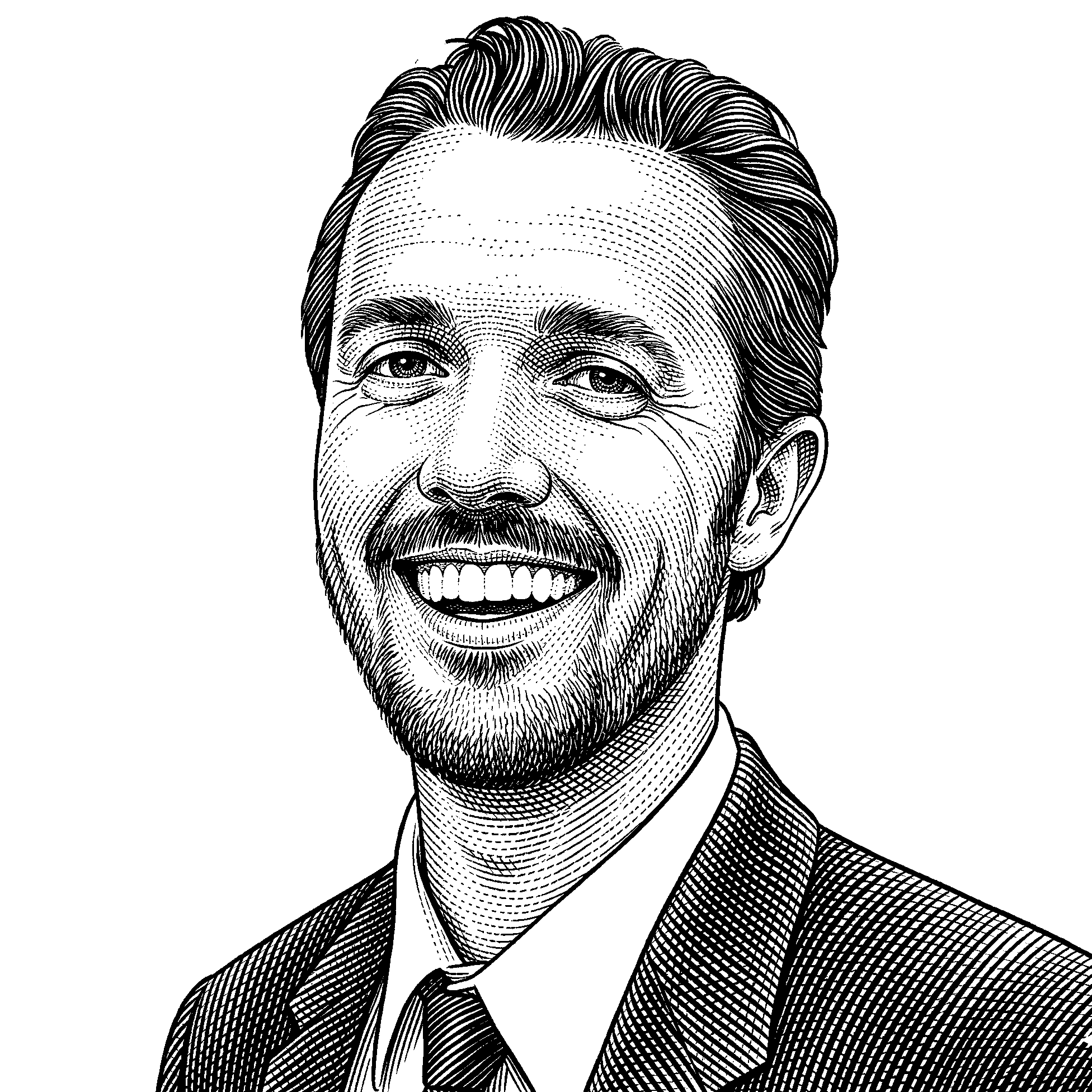
Michael Ferguson is a neuroscientist, researcher, and educator whose work explores the biological foundations of spiritual experience and the intersection of cognitive science and theology. A prominent voice in the dialogue between Mormonism and transhumanism, Dr. Ferguson is widely recognized for his pioneering research into the “religious brain,” seeking to understand how profound spiritual states are mapped within the human nervous system. ¶ Dr. Ferguson’s academic journey began with a focus on physics and communication, but his interest soon shifted toward the complexities of the human mind. He earned his Ph.D. in Bioengineering from the University of Utah, where his doctoral research gained international attention. During this period, he led a landmark study using functional magnetic resonance imaging (fMRI) to monitor the brain activity of devout Latter-day Saints as they reported “feeling the Spirit.” This research identified specific activation in the nucleus accumbens—a region of the brain associated with reward and dopamine—suggesting that spiritual experiences leverage the same neural circuits involved in music, love, and other deeply meaningful stimuli. ¶ Following his doctoral work, Dr. Ferguson completed postdoctoral fellowships at Cornell University and Beth Israel Deaconess Medical Center. He currently serves as an Instructor in Neurology at Harvard Medical School and as a researcher at the Center for Brain Circuit Therapeutics at Brigham and Women’s Hospital. His clinical and research interests have expanded to include the use of brain lesion network mapping and deep brain stimulation to explore the neural circuits associated with religiosity, spirituality, and various neuropsychiatric conditions. ¶ A frequent contributor to the Mormon Transhumanist Association, Dr. Ferguson presented “The Religious Brain Project” at the MTAConf 2014. In this and other presentations, he argues that a scientific understanding of spiritual mechanics does not diminish their sanctity but rather provides a "technological" vocabulary for the soul. He posits that by understanding the neural architecture of transcendence, humanity can better cultivate profound experiences of wonder, connection, and ethical transformation.
Transcript
Speaker 1
Okay, so my name is Michael Ferguson, and I’m a PhD student here at the University of Utah.
Michael Ferguson
I’m studying I’m doing bioengineering, specifically studying functional neural imaging. And the human brain is my passion. And it really informs so much of my interests in both the realms of spirituality as well as the realm of transhumanism. The title of my talk is Trinitarian Archetypes in Darwinian Processes. And I want to start my presentation by examining the power of stories that we tell.
Michael Ferguson
Consider the following scenario. Our ancestors have been human for a very long time. If a normal baby girl, born 40,000 years ago, were kidnapped by a time traveler and raised in a normal family in New York. She would be ready for college in eighteen years. She would learn English along with, who knows, Spanish or Chinese, understand trigonometry, follow baseball and pop music, and she would probably want a pierced tongue and a couple of tattoos. And she would be unrecognizably different from the brothers and sisters she left behind.
Michael Ferguson
What is this all about? What is the differentiation between genetically identical yet interpersonally unrecognizable individuals like the girl in our time traveling kidnapper scenario and her sisters? Implicitly, the differences are not biological. They are ultimately the differences in the collective, accumulated, storied contexts for the humans we are considering.
Michael Ferguson
What is story? And why is it so powerful and persuasive in our development into mature individuality? The human capacity for narrative, like all of our intelligent capacities, is grounded in our biological makeup. For us human beings, though, narrative and story are not only capacities, they are veritable drives. We are a species saturated by fictions and story. and always will be so unless we undergo major, major revamping of the biological infrastructure underpinning our intelligent processes, which incidentally is not the direction I’m going for this talk. Even though it’s a transhumanist conference.
Michael Ferguson
The story of our drive for storytelling and narrative is rooted in the story of the brain itself. Briefly, I would like to look at narrative from the ground up. And I should note that I lean heavily in this explanation on the work of Brian Boyd, who’s authored Fantastic Writing on the Origin of Stories.
Michael Ferguson
First, consider the evolutionary advantage of information sharing. Simply put, by sharing information, we can access more information than we can glean from our own individual efforts. This pooling of information shows up everywhere. From honeybees, they actually do a waggle dance to indicate to their fellow honeybees the direction and the distance of nectar. to the alarm cries of monkeys or birds to alert their fellows to the danger of lurking predators. It’s readily apparent that the pooling of information by a group presents a major source of survival advantage. And indeed, this cooperative communication to share more information than we could glean by our own individual efforts has been a major incentive in the development and evolution of social life.
Michael Ferguson
So why narrative? And why story? Narrative is saturated with information that is social in nature and can guide both our immediate decisions and give us a template of concepts to apply in future circumstances. This is a very important point, that narrative is essentially a compression of social information, which in other words mean that narrative overwhelmingly focuses our attention on strategic information. The salient features, for example, of a narrative would be whether Jack is sleeping with Jill, as opposed to how deeply Jack is sleeping.
Michael Ferguson
Outside of notable exceptions, such as autism, human beings are prone to swiftly both observe and interpret their world. In terms of agency, humanity, individuality, personality, action, and interaction of other human beings around them, and scouring for patterns in each of these social dimensions. In our ancestral environment, strategic social information would almost always have been about people we’d already met and who we would often meet again. We therefore have an endless fascination with character information. Since character information helps us predict the behavior of those we interact with, and because this character information remains relatively stable over time.
Michael Ferguson
Today, many of us human beings are caught up in the fascination of people and lives of media celebrities who we will likely never meet. or with whom we will likely never have consequential interaction. The underpinning reason for our celebrity fascination is probably best understood by evolutionary adaptation. By way of analogy, human dietary choices demonstrate a continued craving for sugar and fat, reflecting old circumstances from the environment of evolutionary adaptation. For our species, we have not yet biologically advanced from these early conditions where sugar and fat craving contributed to our survival. Similarly, our indiscriminate appetite for social information reflects an era in our evolutionary adaptation when we were likely to encounter repeatedly everyone we heard about. Thus, we especially ingest information about the powerful, because their decisions and actions could influence our lives As well as ingesting information about those who command attention, since they were likely to be the social leaders.
Michael Ferguson
The bottom line, then, is that our brains have evolved in a way that we are particularly fond of stories. Because stories are compressed streams of shared information, and further, we’re particularly fond of stories that provide us with social content. Because this type of information is highly useful to us in strategically navigating our world.
Michael Ferguson
Shifting gears for a bit, I want to talk about the Darwinian process. The Darwinian paradigm fundamentally changed the way that we think about not just biological origins, but indeed the way we think about and the way that we model progressive adaptation in virtually every sphere and medium. It’s a very big statement, so let me break it down into a few more specific tenets. Darwin essentially gave us a template for the emergence of design, and it’s a recipe with three discrete ingredients: namely, variation. Replication, and selection.
Michael Ferguson
The combination of those three ingredients into a system is so powerful. That if they are present and if they are sustained for a long enough period of time, you will get design emerging from the system. Let me repeat that. The Darwinian hypothesis is that given the combination of these three ingredients of variation, replication, and selection, it’s not that you might get design. It’s that design will inevitably emerge from the system. You can’t stop it unless you remove one or more of these ingredients from being a part of the mix. This has enormous ramifications for systems like markets, politics, religion, viruses, cognition, music, and art, to name just a few of the many interesting and wonderful examples that we could consider.
Michael Ferguson
The Rosetta Stone for decoding the evolutionary process was, of course, our bio-organic heritage. It was the scrupulous and the careful observation Of biological varieties that led Charles Darwin, among others, to formulate the seminal principles of evolutionary theory. Indeed, this biological domain in which the processes of replication, variation, and selection anciently occurred are the very foundational phenomena which have ultimately begotten myriad other streams of evolutionary systems that constantly whirl around us.
Michael Ferguson
Emergent from our sophisticated biological composition as Homo sapiens is our startling creation of culture. As Mark Lupicella describes it, it is helpful to think about culture as the collective manifestation of value. Where value is that which is valuable to sufficiently complex agents, from which meaning, purpose, ethics, and aesthetics can be derived. As Lu Picella notes, culture is something very special. It has helped life on Earth, particularly Homo sapiens, survive and thrive in ways that sometimes defy belief.
Michael Ferguson
Quoting from an excerpt from his writings in Cosmo-Cultural Evolution, Lu Picella says, as a result of our interests, we have emerged in the universe as valuing agents with meaning, purpose, and morality as cultural derivatives of value. If the universe did not have morality prior, it does now. We, in some nontrivial sense, make the universe a moral entity, however limited the degree of that contribution may appear. We indeed may be just a very small part of the universe that arose by chance, but nevertheless, strictly speaking, the universe now contains morality. The cosmos now has agents caring about other agents and about non-agents as well, and in some cases, caring about the whole of the universe.
Michael Ferguson
The combination of biologically adept species and the emergent phenomena of culture and value inevitably created an outpouring of technology. Physical means toward value-driven ends. From the invention of the wheel to assist in traveling to the creation of the Internet to facilitate communication, technology is the titillating physical manifestation. Of our culture and our value, with culture and value itself processing from the origin of life, i. e. , our bio-organic foundation.
Michael Ferguson
In such a formulation of the rela of the relationships between our biological, cultural and technological heritage, it is frankly difficult for me to not apply the archetypes of Trinitarian theology to each of these respective domains. The father archetype, the origin of life, fitting nicely as a metaphor for a biological emergence. The spirit archetype. the personage of love, nestling over the contemplation of our cultural potential at its best, and the Son, that which is begotten by the Father to create, to complete the Father’s will. fitting into a literal description of technology, the Son himself perhaps being understood as the technology of salvation, if you will.
Michael Ferguson
What does such a convergence of symbols buy us? For one, it starts to make the Christian story teem with transhumanist overtones. Consider, for example, the story of the Holy Spirit fusing with the body to create the Son, and parallelisms of the convergence of biology and cultural value to create the offspring of technology. Or consider the transfiguration of Christ, the moment when the disciples see the essence of the Father radiating from the substance of the Son. Is a moment in the Christian story where the disciples experience a profound epiphany regarding the power and the nature of the one to whom they have been devoted. Surely it will be so in our own transhuman drama. That the eventual manifestation of a human essence through a technological substance Will cause both fear and marveling at the power and the nature of these technologies to which we have been so diligently given.
Michael Ferguson
Secondly, as I noted earlier in my talk, humans crave a storied organization and narrative. Story again is one of the drives of our evolutionary inheritance. And if we are at all serious about a radically cosmic transhuman vision then why not start telling our story by piggybacking on the stories that are already existent? Surely we need not be so humanistically p puritanical and fail to engage a rich legacy of cultural and religious story when the opportunity is before For us.
Michael Ferguson
Lastly, may I invoke one more story from the Christian narrative as a means of communicating one of my fondest hopes for transhumanism. It is a story of the day of Pentecost. As recounted in the book of Acts, chapter 2, verses 1-6, and when the day of Pentecost was fully come, they were all with one accord in one place, and suddenly there came a sound from heaven, as of a rushing mighty wind. and it filled all the house where they were sitting. And there appeared unto them cloven tongues like as of fire, and it sat upon each of them. And they were all filled with the Holy Ghost, and began to speak with other tongues, as the Spirit gave them utterance. And there were dwelling at Jerusalem Jews, devout men, out of every nation under heaven. Now when this was noised abroad, the multitude came together and were confounded, because that every man heard them speak in his own language.
Michael Ferguson
Let’s examine closely what happened here. The causal event for this occurrence was the ascension of the Son, who had become the perfect likeness of the Father, to be at his right hand. Sharing a ruling oneness with Him. From this station, the Son was empowered to send the Spirit to be upon His disciples. So the Pentecost then marks a day when the Holy Spirit, the persona of love, was poured out onto Christian disciples with a calling to build a new heavenly kingdom on the earth.
Michael Ferguson
Think then what is starting to happen and what will continue to happen as technology and as our technical level of understanding the human condition start to reflect not just anthropomorphic physical forms and physiology or even lifelike intelligence, but when our technology starts to become compassionate, empathetic, to show signs of loving kindness Already, we can perceive early rumblings of this potential culture quake.
Michael Ferguson
If you’re not already familiar with it, I encourage you to explore the Cyborg Buddha project launched by doctor James Hughes through the Institute for Ethics and Emerging Technology. Or consider the work, for example, of Dr. John Gottman exploring marital stability and relationship analysis through technical and empirical approaches such as quantification of skin conductance and unconscious microexpression. Exchanged between couples. And while it might sound to some like unattainable science fiction, imagine what it would be like to download to your own consciousness the life experiences. Of a poverty-stricken mother in sub-Saharan Africa, and to understand experientially, through a shared neural synchrony, the sufferings and the challenges faced around this globe on a daily basis. talk about an empathic realization.
Michael Ferguson
If the day of Pentecost was an outpouring of understanding and mission, imagine the outpouring of renewed fileos that will occur when our technology converges to meet the best of our humanity. It well may be the start of a new order, not based upon an external political structure. But a new order of heart based upon mutual love, shared understanding, and mastering the elements that comprise the better angels of our nature.
Michael Ferguson
Sam Keene, a Princeton philosopher, has said that if the cosmos could create butterflies in Einstein’s mind with a chemistry set that contained hydrogen, oxygen, sodium, and fewer than a gross other elements we may be able, by mastering the elements of love, to perform the alchemy that will change our lives from gross matter to gold.
Michael Ferguson
It’s difficult sometimes to discuss these topics in seriousness because they have the tendency to start to dissolve into a sort of slurpy sounding idealism when you get down into the core principles of respect and empathy and compassion. But perhaps this is one of the reasons why the archetypal union of Father and Son is so important in grounding the phenomenon of Pentecost. Or, in our case, why the technicalizing of biological processes provides a certain type of weight and a groundedness toward a serious exploration. of these otherwise ethereal, idealistic attributes of our transhumanity.
Michael Ferguson
As the scientist and sage Carl Sagan has said For small creatures such as we, the vastness is bearable only through love. This, above all things, is why I am a transhumanist. because of the optimism it gives me that we may one day be able to amplify these elements of love and disseminate them so potently that we will find that we have created for ourselves a truly good universe. Thank you very much.