Incarnation: Some Theological-Historical Notes
In an age of seemingly endless possibilities for modifying our bodies, this presentation explores the value of limited embodiment, arguing that constraints and limitations may be prerequisites for cultivating joy, freedom, and connection rather than obstacles to overcome. Drawing on Brian Kershisnik’s painting "Dancing on a Very Small Island," the speaker examines how recent cognitive science has undergone an "embodied makeover," recognizing intelligence as embodied, embedded, enacted, and extended. The talk raises theological questions from the Latter-day Saint tradition—particularly Joseph Smith’s vision of resurrection as precise bodily restoration—suggesting that progress might paradoxically occur through condescension, sacrifice, and abnegation rather than purely through increasing autonomy and agency.
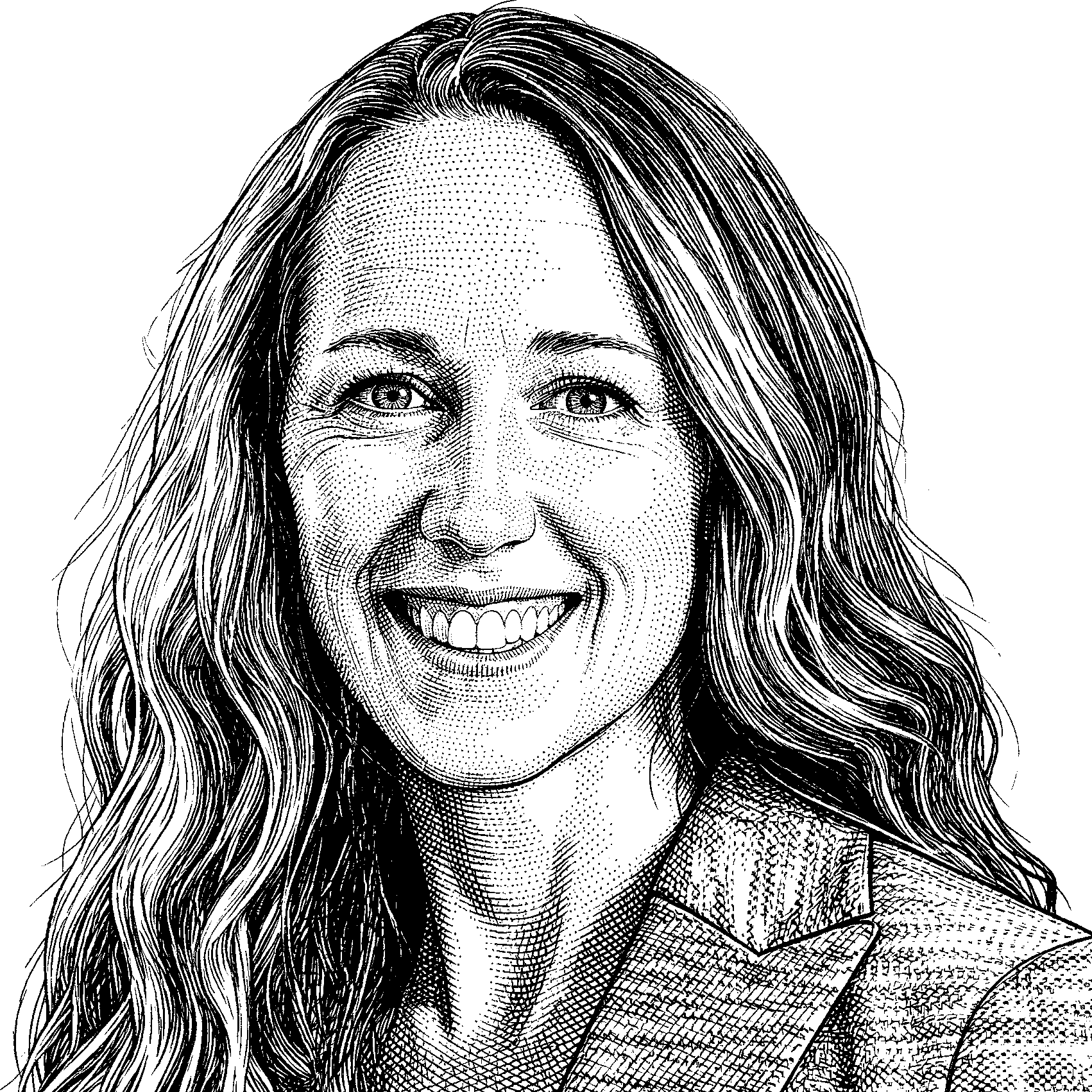
Rachael Givens Johnson is a historian and assistant professor of Interdisciplinary Humanities at Brigham Young University. Her work explores the intersections of embodiment, religious materialism, and transatlantic cultural history. Having earned her Ph.D. in history from the University of Virginia, her scholarship primarily examines peninsular and viceregal Spain during the early modern period, shedding light on the evolving relationship between the physical human body and the sacred. ¶ At the core of Dr. Johnson’s academic pursuits is a fascination with how historical, sensory, and theological shifts impact human experience. She is currently developing a monograph that tracks the changing models of the human sensorium during the Spanish Enlightenment. This research investigates how altered perceptions of sensory experience influenced devotional practices—including the use of physical and mental imagery, religious processions, and sensory technologies—ultimately reshaping notions of subjectivity and intersubjectivity. Furthermore, her scholarly projects extend to late-nineteenth-century transatlantic discourse regarding the deliberate construction of a “modern religion” and the multivalent understandings of “materialism.” ¶ Her academic writings have been featured in prominent journals, reflecting her deep engagement with historical theology. In Eighteenth-Century Studies (2024), she explored reformed social imaginaries of charity, while her 2023 work in the Bulletin for Spanish and Portuguese Historical Studies analyzed shifting conceptions of the sacred and the profane in the Spanish Atlantic. Dr. Johnson’s earlier publications also tackle intriguing intersections of gender and theology, notably her 2015 piece on Mary Wollstonecraft and the “sexless soul” in Religion in the Age of Enlightenment. ¶ Dr. Johnson core beliefs resonate with themes highly relevant to the Mormon Transhumanist Association, particularly the theological implications of embodiment and technological progress. At MTAConf 2024, she delivered a presentation titled Incarnation: Some Theological-Historical Notes, bringing historical and theological depth to contemporary discussions of physical existence, human potential, and divine nature. Her continued engagement with the philosophical challenges of modern technology is evident in her 2025 presentation, “Retrieving the Humanities in the Age of LLMs,” co-presented at Organized Intelligence in Salt Lake City. Additionally, she has contributed to discourse on Mormonism’s unique physical theology, presenting on Latter-day Saint material metaphysics at UC Berkeley in 2024. ¶ Through her teaching—which spans Latin American Humanities, Baroque and Enlightened Catholicism, and the specific study of embodiment and emotion—Dr. Johnson continues to foster a rigorous dialogue on how humanity’s physical, spiritual, and intellectual pursuits intertwine across centuries.
Transcript
Um great, thanks for having me. I’ll be speaking Posing a kind of rhetorical question, in an age of seemingly endless possibilities for modifying our bodies, what might be the virtue in considering the value of a limited embodiment? And I’ll kind of explain what I mean by that.
But I chose a painting by Brian Krishisnik that I think also kind of conveys a little bit of what I’m wanting to explore today. This is called Dancing on a Very Small Island. I love this image. It’s really evocative for what I want to explore today, which is it’s only through our limitations and constraints of our mortal bodies that we’re able to cultivate joy, freedom, curiosity, awe, love, connection.
And while impulses to transcend or fundamentally alter our bodies can manifest entirely understandable yearnings to overcome suffering, or pain, death, or even worse, boredom, we might risk going too far in equating all suffering with evil and limitations as the enemy to agency and growth instead of their prerequisites.
So this sets up a kind of it begs for a synthesis as I kind of pose some modest considerations for this paradox, this idea of progress that doesn’t only focus exclusively on increasing autonomy and agency, but one that also incorporates sacrifice, abnegation, openness, stillness, cooperation, and all other sorts of values that aren’t always quite captured in that way.
And I’ll just say at the outset, these are modest considerations and questions that I’m still engaging in. I have no Nice, neat Hegelian synthesis to offer you at the end of this, but I hope it might be useful or at least provocative. So
First, as we just kind of really breeze through a review of the classic AI view of intelligence and incarnation and embodiment. It stems largely from our kind of first modernist, Descartes’ dualism, where he extends or divides the body the human person into mental and bodily states.
For decades, modernist ideas of matter, where that matter was inert. It was engineerable and controllable. while intelligence, on the other hand, is immaterial, is computational. Basically, intelligence is a computational process that operates across representations. Symbolic, formal, and otherwise, where the brain is treated as a computer.
And obviously, whereas our brains, our computers, are bogged down by biological constraints, you can. engineer computers that aren’t. So the scale in terms of this conception of embodiment and intelligence obviously tilts towards a computer as opposed to a person. As John Searle kind of summarized this kind of classical view, there’s nothing essentially biological about the human mind.
This has changed dramatically in recent years. There’s been a kind of embodied makeover that’s happened in virtually all disciplines. My own discipline is kind of cultural studies and religious history. But virtually all of the cognitive sciences have undergone this embodied makeover, whether it’s the study of language, the study of perception and attention.
They’re kind of summarized nicely by a phrase for E cognition, which, inspired by the philosophical movements of pragmatism and phenomenology. which kind of bracketed these kind of bigger questions of human nature and existence for the more practical considerations of what is it actually like to experience things. And this inspired a tilt towards studying our embodiments, our environments, and our contexts, both social and physical.
So 4E refers to intelligence that is embodied, embedded, and active, and Let me find my fourth E here. Extended. So that’s pretty self-explanatory. By embedded, they mean embedded. Our intelligence depends on our physical and social environments. It can extend into them, wherein we are not just influenced by our environments, but those environments are constitutive for our intelligence.
And by inactive, that means this kind of sense, sense of, you know, it’s motor, it’s enacted, it’s through our postures and our movements. All of those are very much interrelated with notions of intelligence and experience. Okay.
So all of this has kind of trickled into Silicon Valley. I was just reading a recent New York Times article about Roboticists who are shifting more towards trying to develop embodied intelligence, embodied AI. For example, engineering something called Moxie, a kind of child-sized robot that can That can start to develop a kind of spatial intelligence as they realize that there’s more to AI than these kind of formal computational processes.
So that it for many is a shift towards a safer AI and just more authentic ideas of human intelligence.
And yet it still doesn’t capture the really rich phenomenological aspects of intelligence that depend not just on our current physical and social environments, but our evolutionary intelligence, the millions of years that have gone into creating the instincts and reactions and embodied priorities and values that we inhabit.
Let’s see if there’s anything else. I think that’s That’s good for now.
Okay, so with all that being said, now that we know intelligence is grounded in our bodies, what does that mean for altering our bodies? I think what I want to do here is just make a modest case as we, you know, there’s lots of debates about Humans becoming more machine-like or machines becoming more human-like. I’m just going to kind of bracket those questions because, really, for me, I’m just so curious about bodies, and I feel like we know so little about them that before I think about these kind of more macro level changes, I want to consider some theological and practical Implications for my body right now, right here.
So, with that, I’m going to do a couple theological considerations or questions from the Latter-day Saint tradition about bodies, about human bodies. And one is this, it might seem a bit contrarian or even absurd, but we have, right, this Genesis creation story where we’re told that we are created in the image and likeness of God. So, for most of the Christian tradition, that is self-evidently not referring to our physical form, it’s obviously referring to our reason, our intellect, our soul, maybe even our relationality in some kind of Trinitarian model.
Latter-day Saints are among the only ones to interpret it in a very kind of literal way, where our image and likeness is indeed after the nature of God. We have this throughout the Revelations of Joseph Smith, who says, if the veil were rent right now, you would see the God if you were to see him. You would see him like a man in form, like yourselves. The book of Aether has this infamous or famous, either one, according to which side of the Christian spectrum you’re on.
This vision of the brother of Jared, where he is a really peculiar story, where he asks to see the finger of the Lord. He asks for the finger of the Lord to bless these stones, bring light for their Transoceanic journey. And then, when he actually sees the finger of the Lord, he falls down to the ground and he’s shocked because what was metaphor is now literal, and he understands that Christ actually. Appears in a corporeal kind of spiritual body in the form, in the scale, even in the size of himself.
And then we have lots of teachings from Joseph Smith about resurrection, where it’s clear that the thing that he is most eagerly anticipating Is a precise and exact restoration of his father, his brother, his relatives, in the precise form in which he knew them. And that struck a lot of Kind of non-Mormon counterparts is very odd for that to be his kind of focus of resurrection when that was the perfect opportunity for these kind of transhumance or these, you know. Vastly different bodies. No, he wanted them precisely as they were, yearned for that and envisioned that.
So I think it leaves us with a bit of a paradox where instead of Maybe this kind of AI vision where we are creating intelligences and housing them in ever-mutating and transforming bodies, Mormonism might give the flip. image of intelligence that cannot be created, as eternal and preexisting, but peculiarly housed in a stable Continuously recognizable body.
I don’t know if that’s a joke God finds funny, right? Just to make a point about something, but I find it worth considering. That maybe is not just this kind of facile anthropomorphic naivete, but maybe there’s something there about particularity and limits and constraints. paired with unlimited exponential growth of our intelligence and our relationships. Something to perhaps consider.
We run into what I find to be a second kind of paradoxical situation that’s long puzzled me. We have our kind of traditional Platonic hierarchy of matter. where the spiritual and immaterial is clearly superior to the material. And in some ways, Mormonism, for all its monistic ideas, does seem to kind of replicate that sometimes. where it describes spirit as a substance that is more pure, elastic, and refined.
Those are all kind of more positive valences. And yet, we also have the idea that those who have no bodies are less empowered. There’s something about a physical course. temporal body that in some ways is more powerful. And yet, if we flip back to ABA for different sides of the different hierarchies, which ones are flipped, we still have this idea
You know, not just with creedal Christianity, but within the Book of Mormon, of Jesus condescending into a mortal body. The scripture in 1 Nephi is not referring to his mortal ministry and his kind of service or his death. It’s very specifically referring to. His birth through aversion, his birth into flesh. So, something about this mortal body also being a kind of condescension.
Maybe it’s both. Maybe instead of progress being this linear upward trajectory, we progress through condescension. We advance through some kind of abnegation, restraint, sacrifice, and death.
Ultimately, when Joseph Smith says you have to learn how to be gods, he pairs those very explicitly. Jesus, what are you going to do? To lay down my life as my Father did and take it up again. Sometimes I think we hear the second part without the first, and I wonder how that applies to us.
So these kind of polarities, I think, are really interesting as well when we look into some evolutionary history. And I am not a biologist. But from my readings of Simon Conway Morris, he has a really fascinating thesis where instead of understanding evolution,
As this very kind of precarious process of variables, he sees that evolution in the context of a set of given cosmic ingredients that cannot be created or messed with. They are there. And yet, with these set ingredients, is really limitless diversity, not just in a kind of linear sense of evolution like we often associate with the top. But horizontally, radially, as there are many ways in which species adapt, even as they’re all kind of converging. His big thesis is evolutionary convergence. Over time, species find similar mechanisms, whether the eye and the camera eye versus other forms of sight. That can still manifest differently in different species, but share this kind of underlying trajectory, this underlying principle. So I find that to be really interesting.
I think that that Suggests that they’re well, it’s cautionary and suggestive. Suggestive in that we can expand our ideas of evolution outward, not just upwards and onwards. to see how that complicates our idea of progress and advancement.
But also, I think it introduces a kind of problem to wrestle with. When if we want to conflate evolution with progression without seeing the kind of side effects of evolution, the violence, the collateral damage, the parasitical relationships and all of that, I think we can run into Problems that a more metaphysical understanding of matter and eternal laws might be worth kind of reconsidering.
I’m over time, and so I’m just going to kind of end with a very practical consideration that many of us might be more familiar with. Which is how progress can look very different based on our bodies, right? What might be progress to someone, I’m going to use the very
A common example of surrogacy gifts children to people who otherwise could not produce their own children can be not progress for those whose wombs are exploited in unfair economic And racially inflected markets to provide those children, or to the women who find themselves being treated as meat Legos, in the words of one feminist, to be taken apart and dissembled. and fracturing this idea of identity and embodiment in ways that they find dehumanizing rather than advancing and progressive.
So I want to kind of suggest these tensions, these different ways of thinking about progress to help us think through more thoughtfully some of these issues and more inclusively. And that’s where I’ll end. You can contemplate that poem.