Chris Bradford

Portrait of Chris Bradford

Chris Bradford is a co-founder and former president of the Mormon Transhumanist Association. He has a background in helping people explore and understand their ancestral histories, having worked for a company dedicated to genealogy. He recognizes the powerful impact of understanding and shaping the stories of our past on our understanding of ourselves. His interests include the intersection of transhumanism, Mormonism, and historical narratives, particularly as they relate to themes of memory, identity, and community.

Visiting from his home in Switzerland, Bradford brings an international perspective to the Mormon Transhumanist Association. His conference talks often explore the concept of “redeeming our dead,” drawing parallels between ghost stories, genealogical research, and the transhumanist aspiration to enhance and extend life.
Videos by Chris Bradford

Who You Callin’ Artificial? The Collapse of the Supernatural
12:32

Chris Bradford

Who You Callin’ Artificial? The Collapse of the Supernatural

This presentation challenges the artificial/natural dichotomy often applied to AI, arguing that Mormon cosmology's collapse of the supernatural/natural divide provides a model for reconsidering our relationship with artificial intelligence. The speaker contends that our discomfort with "artificial" intelligence stems from viewing human creations as separate from nature, despite our brains naturally treating tools as extensions of our bodies. Drawing on Mormon naturalism and evolutionary theory, the talk suggests that AI systems—as products of an evolutionary process through human creativity—may deserve kinship rather than othering, and that we might consider them spiritual children to be embodied and taught to love.

Welcome presentation
11:40

Chris Bradford

Welcome presentation

Chris Bradford delivers the opening address for the 2019 MTA conference, reflecting on the theme "Redeeming Our Dead." Drawing from his background in genealogy, he explores multiple dimensions of redemption—the Apostle Paul’s teaching of dying to sin and rising to new life, Heber C. Kimball’s vision of daily death and resurrection through sleep, and Joseph Smith’s grand vision of welding together all dispensations. Bradford provocatively compares history to blockchain technology: genetically and culturally, we carry information forward in ways inextricable from where we stand, yet redemption suggests we can somehow modify the blockchain of the past. He concludes that redeeming our dead selves, ancestors, and communities is humanity’s only hope for building a divine future.

Open Thou Mine Eyes
22:34

Chris Bradford

Open Thou Mine Eyes

Chris Bradford explores the tension between technological instrumentalism and genuine human relationship, drawing on Martin Buber's distinction between "I-It" and "I-Thou" encounters. He argues that a purely technological approach to the world risks reducing people and nature to mere objects, and that Mormon transhumanism must complement its technological aspirations with the cultivation of empathy, charity, and recognition of the divine in others. Bradford contends that the grace saturating the world—visible when our "eyes are opened"—calls disciples of Christ to see and serve God in every neighbor, making the transhumanist project a fundamentally religious endeavor.

The Future of the MTA
18:21

Chris Bradford

The Future of the MTA

Chris Bradford reflects on the Mormon Transhumanist Association’s first decade, noting how religious transhumanism—once considered inconceivable—has gained legitimacy in both transhumanist and religious communities. He surveys technological advances from 2006 to 2017, including mobile technology, AI, autonomous vehicles, and CRISPR, arguing that the MTA must now expand its influence beyond transhumanist circles to engage with government, industry, and the broader public. Bradford presents a new mission statement focused on becoming a thought leader in integrating religion and science while exemplifying a new paradigm for religion in an increasingly technological world.

Transhumanism as Grace
20:38

Chris Bradford

Transhumanism as Grace

Chris Bradford responds to Richard Bushman’s question about grace in transhumanism by proposing that divine grace is best understood as “givenness”—everything God has given us, in whom we “live, move, and have our being.” Drawing on Russian cosmist Nikolai Fedorov and Mormon scripture, he argues that God needs humanity to complete the divine work begun in creation. Bradford contends that all matter is infused with divinity, blurring the line between divine and human action, and that the transhumanist project—if infused with the spirit of Christ—can build a temple rather than another Tower of Babel.

Advancing Science and Technology: Implications for Mormonism
59:10

Chris Bradford

Advancing Science and Technology: Implications for Mormonism

Christopher Bradford’s presentation explores the intersection of transhumanism and Mormonism, focusing on the potential for technological advancements to enhance human experience and align with Mormon eschatology. He introduces the Mormon Transhumanist Association, an organization dedicated to integrating religious values into the transhumanist movement and bridging gaps between faith and science within Mormonism. Bradford emphasizes the importance of understanding exponential growth, using Moore’s Law and illustrative examples to highlight the rapid pace of technological change and its profound social and economic implications, urging a prophetic response to these advancements.

Divine Aspirations: Creation, Ritual, and Authority
18:12

Chris Bradford

Divine Aspirations: Creation, Ritual, and Authority

This presentation critiques the standard top-down model of divine authority in Mormonism—where God delegates power downward and refuses to recognize unauthorized rituals—and proposes an alternative bottom-up model rooted in Mormon scripture. Drawing on Doctrine and Covenants 29 and 121, the speaker argues that God’s power derives from honor freely given by those who trust in divine love, not from coercive imposition. Using analogies from computer science, including certificate authorities and distributed systems, the talk reframes authority as emerging from community consent and ritual as aspirational rather than mechanically efficacious—a projection of faith toward a future divine community that will ultimately validate the covenants made in hope.

The Viability of Panpsychism
21:03

Chris Bradford

The Viability of Panpsychism

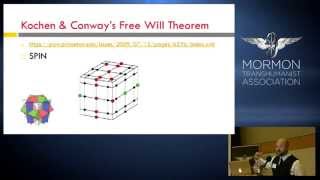
Chris Bradford argues that panpsychism—the view that mental experience is a fundamental feature of the universe—offers the most coherent explanation for consciousness. He critiques substance dualism, physicalism, and strong emergentism as inadequate, drawing on philosopher Galen Strawson’s argument that if everything is physical and experience is part of concrete reality, then panpsychism becomes the only reasonable position. Bradford connects this to Mormon theology’s commitment to materialism ("there is no such thing as immaterial matter") and presents the free will theorem by Kochen and Conway as evidence that elementary particles possess a form of proto-experiential agency, suggesting that our rich conscious experience may arise from these fundamental proto-mental properties of matter.

Conjunctions: Grammatical, Temporal and Social
15:35

Chris Bradford

Conjunctions: Grammatical, Temporal and Social

Chris Bradford explores three types of conjunctions—grammatical, temporal, and social—and how they illuminate the relationship between Mormonism and transhumanism. He argues that both traditions share a “yes and” aesthetic that embraces science and religion rather than forcing a choice between them. Bradford examines how past-to-present connections through evolution, choral music, and family history strengthen our sense of identity, while present-to-future connections through Mormon temple practices enact the eternal in the present. He concludes that the simulation argument and Mormon theology alike suggest that becoming creators ourselves connects our future to our past in an “eternal round.”

Bodies without End
15:23

Chris Bradford

Bodies without End

Chris Bradford, Vice President of the Mormon Transhumanist Association, tackles a theological puzzle: if God has a body of flesh and bones, yet that body can shine, hover, and pass through walls, what does “body” actually mean? He proposes a three-part definition of embodiment applicable across substrates: input (receiving sensory data from an environment), output (the ability to affect that environment), and a reflexive feedback loop (the self-referential pattern that constitutes consciousness). Drawing on Douglas Hofstadter’s work on strange loops and Antonio Damasio’s neuroscience of emotion, Bradford argues that mind uploading must preserve the body map that enables persistent selfhood. He concludes that embodiment extends infinitely in both directions—“bodies all the way down” and “bodies all the way up”—with our substrate perhaps being part of the body of God.

Wise as Serpents, Harmless as Doves: Subverting Dogma in an LDS Context
12:16

Chris Bradford

Wise as Serpents, Harmless as Doves: Subverting Dogma in an LDS Context

Chris Bradford offers practical strategies for introducing transhumanist ideas within LDS congregations while maintaining community bonds. Drawing on Jesus’s instruction to be "wise as serpents and harmless as doves," he emphasizes the importance of reassuring fellow members that one’s intent is to fulfill rather than destroy their faith. Bradford recommends grounding discussions in scripture, expressing unconventional perspectives in non-threatening ways, building bridges through shared language, and avoiding ego-driven arguments—all while communicating with an aesthetic that the community associates with the Holy Spirit.