creation
Articles (7)
The Gospel of Tron
Explore the spiritual parallels between programming, creation, and Mormon theology—how creative processes mirror divine emergence and draw us closer to understanding God and eternity.
Transhumanist Advent: They did all eat, and were filled
Explore how modern agriculture and emerging technologies like genetic engineering and vertical farming echo Christ's miracle of multiplying loaves to feed the hungry.
The redemption of artificial intelligence
Exploring whether artificial intelligences can be redeemed in God's plan, examining Christian and Mormon theological models of the soul's origin and their implications for AI.
Creator Status: Are We There Yet?
Exploring how No Man's Sky's 18 quintillion procedurally generated planets brings humanity closer to creator status—and what that means for our theological and technological future.
Spaceship Earth
Explore how small innovations—from cave drawings to digital technology—shape humanity's future, inspired by Epcot's Spaceship Earth and a Mormon Transhumanist perspective.
Authors (2)

Albert Einstein
Albert Einstein (1879–1955) was a German-born theoretical physicist widely regarded as one of the most influential scientists in human history. His contributions to physics fundamentally reshaped humanity’s understanding of space, time, energy, and the cosmos. Born in Ulm, in the Kingdom of Württemberg in the German Empire, Einstein developed the special and general theories of relativity, and his mass–energy equivalence formula, E = mc², has been called the world’s most famous equation. In 1921, he received the Nobel Prize in Physics for his discovery of the law of the photoelectric effect, a pivotal contribution to the development of quantum theory. Einstein held academic positions at the University of Zurich, Charles University in Prague, the Prussian Academy of Sciences, and, after emigrating to the United States in 1933, the Institute for Advanced Study in Princeton, New Jersey, where he remained until his death. Beyond his scientific achievements, Einstein was a profound philosophical thinker who often reflected on the relationship between science, mystery, and what he described as a “cosmic religious feeling.” He expressed deep reverence for the rational structure of the universe, once stating that “the most incomprehensible thing about the world is that it is comprehensible.” While not religiously orthodox, his sense of awe at the intelligibility of nature resonates with transhumanist and theological themes of humanity’s capacity to comprehend and participate in the divine order of creation. Einstein’s legacy speaks powerfully to the Mormon Transhumanist vision: his life exemplifies the extraordinary potential of the human mind to transcend prior limitations, to unveil deeper truths about reality, and to expand the horizon of what humanity can know and become.

Nikolay Fyodorov
Nikolay Fyodorovich Fyodorov (9 June 1829 – 28 December 1903) was a Russian Orthodox Christian philosopher, religious thinker, and futurologist who founded the intellectual movement known as Russian cosmism—a direct precursor to modern transhumanism. Born as Nikolay Pavlovich Gagarin, the illegitimate son of Prince Pavel Ivanovich Gagarin, he studied at the Richelieu Lyceum in Odessa before serving as a teacher and later joining the Rumyantsev Museum as a librarian in 1878. Called the “Socrates of Moscow,” Fyodorov was respected and admired by Leo Tolstoy, Fyodor Dostoevsky, and Vladimir Solovyov. His major contribution to philosophy was the “Common Task”—humanity’s collective mission to regulate the forces of nature, defeat death, and resurrect ancestors through scientific means. He advocated for radical life extension, physical immortality, and the literal resurrection of the dead, insisting that knowledge without action was worthless. Fyodorov opposed intellectual property and never published during his lifetime. His selected articles were printed posthumously as Philosophy of the Common Task (also known as Philosophy of Physical Resurrection ). His ideas influenced diverse figures, from rocket pioneer Konstantin Tsiolkovsky to composer Alexander Scriabin. He died of pneumonia in 1903 in a shelter for the poor; his grave was destroyed by the Soviet government in 1930. Fyodorov’s synthesis of Orthodox Christianity with scientific ambition for immortality and resurrection makes him a foundational figure for understanding the religious dimensions of transhumanist thought.
Quotations (7)
 Spencer W. Kimball
 John A. WidtsoeJohn A. Widtsoe
 Brigham Young
Videos (4)
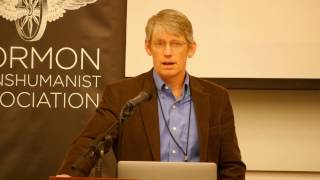
George Handley
Caring for Creation: an LDS Perspective
George Handley outlines ten distinctive LDS doctrines that provide theological resources for environmental stewardship, including the belief that Earth is humanity's intended eternal home rather than a mere way station, that bodies and sensory experience are to be treasured, and that all life forms were created spiritually before physically and are entitled to "multiply and replenish." He emphasizes that LDS teachings on creation from unorganized matter (rather than ex nihilo) imply reverence for natural processes, while scriptures like the Word of Wisdom and the Law of Consecration mandate eating locally, consuming sparingly, and redistributing resources to the poor. Handley argues that the Anthropocene demands Latter-day Saints bring together both scientific literacy and religious values to adequately respond to environmental challenges.
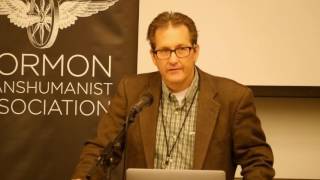
Steven Peck
The Evolution of Novelty in an Open Universe: Requiem for Laplace's Demon
Steven Peck challenges the deterministic "block universe" of Laplace's demon, arguing that genuine randomness—rooted in quantum events—bubbles up through biology to create an open, evolving cosmos. Drawing on chaos theory, emergence, and evolutionary biology, he contends that novelty is continuously generated in ways that were never predetermined at the Big Bang. For Peck, this openness has profound theological implications: if God has an embodied, biological nature, then faith, hope, and charity are not merely earthly virtues but eternal necessities for navigating a universe where the future remains genuinely unwritten.
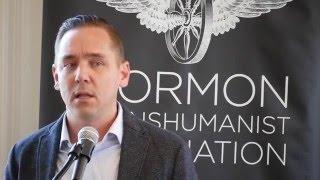
Joseph West
An open letter to the lost children of Mormonism
Joseph West addresses the "lost children of Mormonism" through Nietzsche's parable of the camel, lion, and child. The camel gladly bears burdens; the lion rebels against old values with a sacred "no"; but only the child can offer the sacred "yes" needed for genuine creation. West argues that Mormonism's radical heritage—alternative family structures, innovative economics, the belief that humans can become gods—was suppressed when the community capitulated to mainstream American values. He calls for reconciliation between faithful "camels" and disaffected "lions," urging both to seek the "sacred feminine" wisdom that can guide them out of the wilderness.
Lincoln Cannon
Trust in Posthumanity and the New God Argument
Lincoln Cannon presents the New God Argument, a logical framework demonstrating that trust in humanity's posthuman potential should lead to faith in God. The argument combines three sub-arguments: the angel argument (if prehumans are probable, posthumans probably already exist), the benevolence argument (posthumans are probably more benevolent than us), and the creation argument (posthumans probably created our world). Cannon shows how this reasoning aligns with Mormon theology—particularly Joseph Smith's teaching that God was once as we are now—and responds to Richard Dawkins's observation that sufficiently advanced extraterrestrials would be indistinguishable from gods.