naturalism
Articles (15)
Mormon Naturalism
Explore how Mormon theology's unique naturalism—rejecting creation ex nihilo and a supernatural God—bridges faith and science, redefining divinity within natural law.
Transhumanist Advent: The man who had been mute spoke
Explore how modern technologies like SignAloud and MotionSavvy echo biblical healing miracles, giving voice to the mute through innovation and compassion.
When to be like Han Solo
Explore how Han Solo's reluctant heroism mirrors transhumanist efforts to overcome mortality through science—and why even skeptics should boldly engage the cause.
My Depression and the God of Esau
A personal essay exploring the intersection of clinical depression and Mormon missionary life, examining how faith frameworks can both complicate and illuminate mental health struggles.
Almost an Atheist: A Mormon Welcome to Transhumanist Atheists
Explore how Mormon Transhumanism bridges theism and atheism through one member's journey from divine experiences to skeptical inquiry, finding common ground in shared human purpose.
Authors (17)

Alan Watts
Alan Wilson Watts (1915–1973) was a British-born American philosopher, writer, and speaker best known for popularizing Eastern philosophy—particularly Zen Buddhism, Taoism, and Hinduism—for Western audiences. He remains one of the most influential interpreters of Asian religious thought in the twentieth century. Watts began his career in England, where he was involved with the Buddhist Lodge in London. He later moved to the United States, briefly serving as an Episcopal priest before leaving the ministry to pursue a broader philosophical vocation. He became a professor and dean at the American Academy of Asian Studies in San Francisco and authored over twenty-five books, including The Way of Zen (1957), Psychotherapy East and West (1961), and The Book: On the Taboo Against Knowing Who You Are (1966). His lectures, many of which survive as recordings, continue to reach millions worldwide. Watts’s central teaching—that the individual self and the universe are fundamentally one—resonates with Mormon Transhumanist themes of theosis and the expansive potential of consciousness. His insistence that human beings are not merely in the universe but of it, expressions of a deeper cosmic process, parallels the tradition’s interest in humanity’s divine trajectory. However, significant differences exist. Watts generally rejected the concept of a personal God, viewing divinity as an impersonal process rather than a being with whom one could have a relationship. He was skeptical of doctrines of sin and moral depravity, seeing guilt as a psychological obstacle rather than a theological reality. He also questioned the Western emphasis on individual free will, favoring a view of spontaneous action aligned with Taoist wu wei . Despite these divergences, his lifelong project of dissolving boundaries between the sacred and the secular, the human and the divine, offers rich material for dialogue with Mormon Transhumanist thought.

Carl Sagan
Carl Edward Sagan (1934–1996) was an American astronomer, planetary scientist, cosmologist, and one of the most influential science communicators of the twentieth century. His ability to convey the wonder of the cosmos to a broad public audience made him a defining figure in popular science. Sagan spent much of his career at Cornell University, where he served as a professor of astronomy and director of the Laboratory for Planetary Studies. He contributed significantly to planetary science, including research on the atmospheres of Venus and Titan, and played a key role in NASA's Mariner, Viking, Voyager, and Galileo missions. He helped design the Pioneer plaque and the Voyager Golden Record—messages from humanity launched into interstellar space. His 1980 television series Cosmos: A Personal Voyage became one of the most widely watched programs in public television history, and his novel Contact (1985) explored humanity's first encounter with extraterrestrial intelligence. Sagan was a passionate advocate for scientific literacy, critical thinking, and the search for life beyond Earth. While he identified as an agnostic and approached questions of God and transcendence through a scientific lens, his work resonated deeply with themes central to transhumanist thought: the aspiration to transcend present human limitations, the ethical stewardship of technology, and a profound reverence for the potential of conscious life in the universe. His famous declaration that "we are a way for the cosmos to know itself" echoes theological ideas of humanity's participatory role in creation and theosis—the notion that intelligent beings may grow toward ever-greater understanding, compassion, and capacity. Sagan's legacy continues to inspire those who see science and wonder as complementary paths toward human flourishing.
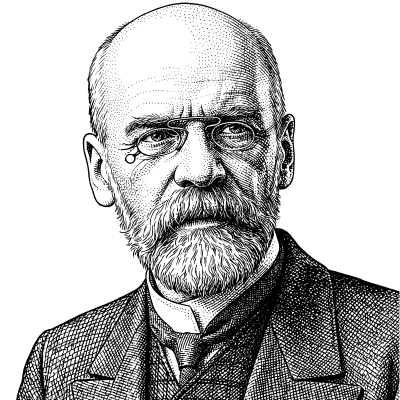
Emile Durkheim
Emile Durkheim was a pioneering French sociologist and philosopher, widely recognized alongside Karl Marx and Max Weber as one of the principal architects of modern social science. Born into a devout Jewish family in Épinal, France, Durkheim descended from a long line of rabbis. However, he broke with this tradition at an early age to lead a thoroughly secular life, dedicating his intellect to the scientific study of society rather than theology. A precocious student, Durkheim entered the prestigious École Normale Supérieure in 1879, where he studied alongside future intellectual luminaries such as Jean Jaurès and Henri Bergson. Dissatisfied with the abstract nature of traditional philosophy and the lack of a social science curriculum in France, he turned to the positivist theories of Auguste Comte and Herbert Spencer. He sought to establish sociology as a rigorous, empirical science, distinct from psychology and philosophy, capable of diagnosing social pathologies and guiding human progress. Durkheim’s academic career was defined by a prolific output of foundational texts. In 1893, he published his doctoral dissertation, The Division of Labour in Society , which introduced the concept of “anomie”—a breakdown of social norms resulting from rapid modernization. He argued that as societies evolve from primitive “mechanical” solidarity to complex “organic” solidarity, the interdependence of individuals becomes the new social glue. Two years later, he published The Rules of Sociological Method (1895) and established the first European department of sociology at the University of Bordeaux. His 1897 monograph, Suicide , pioneered the use of statistical methods in social research, demonstrating that even the most intensely personal act is influenced by social currents. Of particular relevance to the intersection of theology and human development was his final major work, The Elementary Forms of the Religious Life (1912). In this text, Durkheim analyzed religion not as a divine revelation but as a fundamental social fact—a “system of beliefs and practices relative to sacred things” that unites adherents into a single moral community. He introduced the concept of “collective consciousness” (or collective conscience), positing that the “sacred” is essentially society worshipping its own collective power. This sociological perspective suggests that while religious forms may evolve, the function of religion—to bind humanity together and preserve collective knowledge—remains a permanent and essential feature of human existence. Durkheim’s influence widened when he became a chair at the Sorbonne in Paris, where he profoundly shaped the French educational system. Tragically, his life was cut short by the First World War; devastated by the death of his son André on the war front, Durkheim died of a stroke in 1917. His legacy endures in the structural-functionalist approach to sociology and his enduring insight that human consciousness is deeply rooted in the collective social fabric.
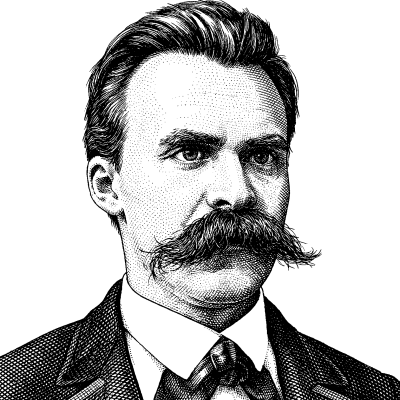
Friedrich Nietzsche
Friedrich Wilhelm Nietzsche (1844–1900) was a German philosopher, cultural critic, and philologist whose provocative ideas about morality, religion, and human potential have profoundly influenced modern thought. His concept of the ‘Übermensch’ (often translated as ‘overman’ or ‘superman’) and his call for humanity to transcend conventional values have made him a touchstone for transhumanist philosophy, even as his ideas remain subject to intense debate and varying interpretations. Born in Röcken, Prussia, Nietzsche was the son of a Lutheran pastor who died when Friedrich was four years old. He showed exceptional academic ability and became a professor of classical philology at the University of Basel at the remarkably young age of twenty-four. However, chronic illness forced his retirement from teaching in 1879, after which he spent the next decade as an independent philosopher, living modestly in boarding houses across Switzerland, Italy, and France while producing his most important works. Nietzsche’s major works—including Thus Spoke Zarathustra , Beyond Good and Evil , On the Genealogy of Morality , and The Gay Science —challenged the foundations of Western morality and religion. He famously proclaimed that ‘God is dead,’ not as a celebration but as a diagnosis of modern culture’s loss of transcendent meaning. His response was to call for a ‘revaluation of all values’ and the emergence of individuals who could create new meaning through the exercise of will. The concept of the Übermensch represents Nietzsche’s vision of human potential. Rather than a biological superman, Nietzsche envisioned a human being who had overcome the limitations of conventional morality to create new values and embrace life fully. This figure would say ‘yes’ to existence, including its suffering, through what Nietzsche called amor fati —love of fate. The Übermensch was to be the meaning of the earth, replacing otherworldly hopes with earthly creativity and self-overcoming. In 1889, Nietzsche suffered a mental collapse from which he never recovered, spending his final years in the care of his mother and sister. Despite the tragic end of his productive life, his influence only grew after his death. Transhumanists have drawn on his vision of human self-transcendence, though they typically emphasize technological means of enhancement that Nietzsche himself never contemplated. His insistence that humanity is ‘something to be overcome’ and his rejection of static human nature resonate with contemporary projects aimed at expanding human capabilities.

Johannes Kepler
Johannes Kepler (27 December 1571 – 15 November 1630) was a German mathematician, astronomer, and natural philosopher who fundamentally transformed humanity’s understanding of the cosmos. Born in Weil der Stadt, Germany, to a soldier father and an herbalist mother who was later accused of witchcraft, Kepler studied at the University of Tübingen under Michael Maestlin, who taught him the Copernican heliocentric system. In 1596, Kepler published Mysterium Cosmographicum ( The Cosmographic Mystery ), the first published defense of Copernicus’s sun-centered model. After being forced out of his teaching position in Graz due to his Lutheran faith, he moved to Prague in 1600 to work for the renowned astronomer Tycho Brahe. When Tycho died suddenly in 1601, Kepler succeeded him as imperial mathematician to Holy Roman Emperor Rudolf II. Kepler’s greatest achievement was his three laws of planetary motion: that planets move in elliptical orbits with the sun at one focus (1609); that a line connecting a planet to the sun sweeps equal areas in equal times; and that the square of a planet’s orbital period is proportional to the cube of its mean distance from the sun (1619). These laws, published in Astronomia Nova (1609) and Harmonices Mundi (1619), laid the foundation for Newton’s law of universal gravitation. Called the “founder of celestial mechanics,” Kepler was the first to identify natural laws in the modern sense. His fusion of physics and astronomy created modern astronomical science, demonstrating that the same physical principles governing motion on Earth apply throughout the universe—a revolutionary insight with profound implications for understanding humanity’s place in the cosmos.
Quotations (30)
 John A. Widtsoe
 Jeffrey R. Holland
 Brigham Young
 David O. McKay